Receipt-based promotions remain one of the highest-ROI channels available to brands, and the reason hasn’t changed: a receipt is proof of an actual purchase, not a click or an impression. When a shopper uploads a receipt, a brand gets a validated purchase transaction, a chance to reward the exact behavior it wants to see more of, and a doorway into first-party data to connect with customers after they’ve already walked away from the shelf.
What has changed since this list first ran is the sophistication on both sides of that transaction. AI tools now make it possible to generate a convincing fake receipt in seconds, and enterprise brands running programs at scale need fraud prevention built into the platform from day one, not added after a campaign gets exploited.
Receipt promotions are:
- Easy to set up
- Cost-effective
- Customizable
- Flexible and Scalable
- Data-rich
|
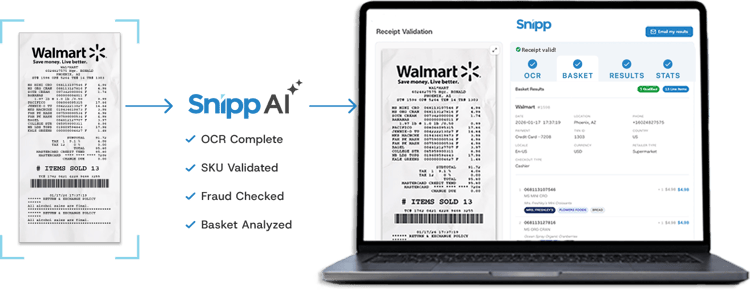
See Receipt Validation in Action Snipp’s AI-powered receipt validation demo lets you upload a receipt and watch instant OCR extraction, fraud checks, and basket analysis run in real time, no signup required. Try the receipt validation demo → |
What is Receipt Marketing?
The POS receipt, usually stuffed into a shoppers’ pocket or bag to be tossed out and forgotten, is a marketer’s holy grail. It carries an abundance of information about the shopper’s behavior. It includes information that shoppers would rarely provide directly, including where, when and in what mix they make their purchases. This makes the receipt a very sophisticated marketing tool.
The images of shopper receipts are usually processed and analyzed through Optical Character Recognition (OCR) tools (receipt OCR tools) in order to extract individual shopper data, right down to product SKU level, without the need to coordinate with retailers or integrate with their POS systems. Analyzing the data collected from shopper receipts allows brands to customize their promotions and rewards programs, and bring a high level of personalization to their offerings for shoppers.
10 Brand Objectives You Can Achieve with Receipt Marketing Programs
Below are 10 brand objectives receipt processing programs can help you hit, along with a closer look at what fraud protection should actually include.
1. Driving Sales and Basket Size
Receipt programs are one of the few promotional mechanics that can deliver on a minimum spend or a minimum number of items qualification before a reward is issued, which makes them a direct lever on basket size rather than a general awareness play. Because the reward only triggers once the receipt clears validation, brands can set the exact purchase behavior they want to incentivize.
Example: Ferrara’s “Summer Concert Cash” program rewarded shoppers who purchased three or more Ferrara products in a single transaction with a $5 promo code and an entry into a sweepstakes, tying the reward directly to basket composition.
2. First-Party Data Acquisition
Every receipt submitted to a program is a snapshot of real purchase behavior: what a shopper bought, where, and when, often alongside what else was in the basket. That data only grows more valuable as third-party cookies keep eroding, and it’s structured well enough to feed segmentation and targeting directly.
Example: Danone Activia's Gut Health Challenge asked shoppers who spent $15 on Activia products to upload a receipt for a $5 reward, then used that same submission to trigger personalized engagement emails tied to each shopper's entry date, on top of daily $500 instant-win drawings, turning routine receipt data into an ongoing re-engagement channel rather than a one-time redemption.
3. Simplifying Customer Experiences
The programs that convert best ask the least of the shopper. Receipt processing replaces codes-on-pack or mail-in redemption and makes it easier to automatically collect points for purchase and other activities, minimizing a challenge in many loyalty and rewards programs.
Example: Nestlé Purina’s Purina Perks loyalty program lets members earn 10 points per dollar spent by uploading a receipt from their phone or scanning it in store, plus a 400-point bonus for building a pet profile. That simplified flow was part of what earned Purina Perks a Loyalty360 Award for Loyalty Program Design.
4. Driving an Omnichannel Customer Experience
Because receipt validation isn’t tied to a single retailer’s point-of-sale system, it lets brands accept proof of purchase from anywhere a shopper actually buys, in store, online, or direct-to-consumer, and reward it under one program.
Example: Reckitt’s Enfamil Rewards program accepts receipts from any retail channel - in-store, online, and DTCand applies segmented offers based on first-party data captured across however its members actually shopped, giving the brand one loyalty program instead of a patchwork of channel-specific ones.
5. Driving Retail Specific Sales & Engagement
A receipt program can be scoped to a single retail partner, which makes it a useful tool for strengthening a specific account relationship or supporting a joint business plan.
Example: brüst USA’s digital rebate program at Costco asked shoppers to purchase qualifying brüst products, register, and upload a receipt for verification, then paid out a $5 Venmo rebate on approval, driving trial through a specific retail partner with a fast, low-friction redemption.
6. Driving Cross-Brand Sales
Receipt validation can check for multiple SKUs across different brands in the same transaction, which makes co-branded promotions between complementary or non-competing brands straightforward to run and to measure.
Example: Canada Dry and Conagra paired up on a gift-with-purchase promotion that rewarded a retailer-specific gift card, or a $5 Visa card where one wasn't available, when a shopper purchased both brands in the same transaction, with Snipp managing the program end to end from receipt validation through fulfillment.
7. Encouraging New Product Trials
New SKU launches live or die on trial, and a receipt-validated reward tied to a specific product gives hesitant shoppers a low-risk reason to put a new item in the basket for the first time.
Example: Church & Dwight’s Arm & Hammer cat litter rebate asked shoppers who spent $20-plus on qualifying Arm & Hammer cat litter to register and upload a receipt, then paid a $6 digital prepaid card on approval, lowering the barrier to trying the portfolio for the first time.
Another example: Suntory’s Basil Hayden on-premise program rewarded guests who bought two qualifying Basil Hayden cocktails at participating bars and restaurants with a Venmo rebate worth up to $15, effectively letting one drink cover a friend’s and turning trial into a shared occasion.
8. Driving Engagement & Sales Leveraging Partnerships / Sponsorships
Pairing a receipt promotion with a sponsorship a brand already invests in, a sports league, a streaming platform, a cultural event, gives the reward emotional weight that a generic discount doesn’t have.
Example: WK Kellogg Co.’s Cocoa Loops x Wonka Golden Ticket sweepstakes turned a limited-edition cereal launch into an entertainment tie-in: purchase-based receipt uploads earned sweepstakes entries toward prizes including a trip to Netflix House Las Vegas, with custom creative that turned the receipt upload itself into part of the story.
Another example: Nestlé KitKat’s NHL Heritage Classic sweepstakes leveraged KitKat’s NHL partnership in Canada, rewarding receipt-validated purchases with entries to win a trip to the 2026 NHL Heritage Classic in Winnipeg, with bilingual support to reach English- and French-speaking fans.
9. Improving Program Efficiencies
In B2B contexts, receipt and invoice-based programs replace manual transaction rebate processing with automated data capture, which is as much an efficiency win as a marketing one.
Example: IKO's ROOFPRO loyalty program let individual contractors earn points by submitting photos of invoices and roofing receipts, while distributors uploaded bulk invoices, replacing manual processing across the US and Canada with automated, configurable rebate handling by country, state or province, and city - and providing more actionable data to increase contractor and distributor satisfaction.
10. Scaling Activations – Geography and Language
A single receipt processing platform can support many markets at once, applying localized rules, processing any language and currency, and compliance requirements per country without a separate build for each one.
Example: Gillette's gaming-themed gift-with-purchase program ran across the UK, Ireland, Mexico, and Germany at once, validating Amazon receipts through Snipp's OCR technology and rewarding qualifying purchases with Xbox Game Pass vouchers, delivered through one centralized platform spanning three languages and four markets. Gillette's gaming-themed gift-with-purchase program ran across the UK, Ireland, Mexico, and Germany at once, validating receipts through Snipp's OCR technology and rewarding qualifying purchases with Xbox Game Pass vouchers, delivered through one centralized platform spanning three languages and four markets.
Fraud Prevention: What Every Receipt Program Needs to Get RightReceipt fraud has scaled right along with the technology available to run it. Experian found that 35% of UK businesses were targeted by AI-related fraud in the first quarter of 2025, up from 23% the year before. Industry estimates put annual losses from coupon and promotion fraud at roughly $100 billion globally, and the Association of Coupon Professionals puts fraud rates on individual campaigns anywhere from 3% to 15% of total redemptions. The cost isn’t only the fraudulent payout. Vericast found that 58% of consumers say a poor promotional experience changes how they see a brand, and a program that pays out to fraudsters is also a program that runs out of budget before it reaches the real shoppers it was built for. What fraud actually looks like on a receipt program
What a fraud-resistant receipt program looks likeThe pattern across every fraud-prevention resource Snipp has published is the same: no single check catches everything, so protection has to be layered. That means image forensics that catch pixel inconsistencies and metadata mismatches, duplicate detection that hashes every receipt against the full program database, behavioral analytics that flag unusual submission velocity or device patterns, and human review for anything the automated layer flags as high risk. Snipp’s AI-powered receipt processing platform runs these checks on every submission by default, OCR extraction, fraud detection, and basket analysis happen in the same pass, so a program isn’t forced to trade speed for security. You can watch the checks run on an actual receipt in the receipt validation demo, no account required. |
4 Considerations for Powerful Receipt Marketing
-
Reach and relevance: A receipt program is only as strong as the audience it reaches, so start with where your buyers already shop and what proof of purchase looks like in that channel.
-
Rewards strategy: Match the reward to the behavior you want. A basket-size objective calls for a spend threshold; a trial objective calls for a reward tied to a single SKU.
-
Friction reduction: Every extra step between purchase and reward is a chance for a shopper to give up. Receipt upload should be the only step that matters.
-
Data leverage: Treat the receipt data you collect as an asset beyond the campaign it came from. It should feed segmentation, personalization, and the next program you run.
What's the ROI of Receipt Marketing?
A receipt program should be measured the same way any other revenue-driving channel is: not only by how many people redeemed, but by what those redemptions cost to earn and what they returned. A simple three-stage cycle keeps that measurement disciplined from one program to the next.
| Plan | Review | Optimize |
|
|
|
| Ask: | Ask: | Ask: |
|
|
|
| Set the objective before the mechanic. Decide upfront whether success looks like basket size, new-to-brand trial, or retailer-specific lift, and size the reward and budget against that one goal rather than several at once. | Track approval rate against total submissions, not just entry volume. A high submission count paired with a low approval rate is often a fraud signal as much as it is a performance one, which is why the fraud checks above sit inside the same platform as the redemption data. | Use what the receipt data showed about basket composition and shopper behavior to tighten the next run, adjusting spend thresholds, reward value, or channel mix based on what actually moved the objective rather than what was assumed going in. |
Frequently Asked Questions
What is receipt marketing?
Receipt marketing is any promotion, loyalty, or rebate program that uses an image of a purchase receipt as proof of purchase, rather than a on-pack code or point-of-sale integration, to validate and reward a transaction.
What types of programs can receipt data power?
Receipt validation supports gift-with-purchase promotions, instant-win and sweepstakes mechanics, ongoing loyalty programs, rebates, and B2B invoice-based loyalty, within the same platform. They can also validate non-purchase actions such as surveys, referrals, or social engagement - allowing brands to design flexible campaigns that meet shoppers wherever they are.
What’s the ROI advantage of receipt programs over traditional promotions?
Receipt programs validate an actual purchase rather than an intent to purchase, so reward budget goes toward confirmed transactions and the data collected reflects real basket behavior instead of self-reported survey responses.
What technology supports receipt processing?
Modern receipt platforms use AI-powered OCR to extract line items, totals, and retailer data from an image in seconds, then validate that data against campaign rules without requiring integration with a retailer’s point-of-sale system.
How do receipt programs prevent fraud?
Through a layered approach: image forensics to catch AI-generated or edited receipts, duplicate detection that hashes submissions against the program database, behavioral analytics to flag abnormal submission patterns, and manual review for high-risk cases. With AI-related fraud targeting 35% of UK businesses in the first quarter of 2025, up from 23% the year before according to Experian, fraud detection built into the platform from the first submission is no longer optional for programs run at scale.
What’s Next
If program ROI and receipt fraud are both on your list, here’s where to go from here.
Read the solution sheet: Snipp Receipt Processing and Validation
Explore the platform: Snipp Receipt Processing and Fraud Detection and Prevention
Try it yourself: Upload a receipt to the demo and watch OCR extraction, fraud checks, and basket analysis run in real time. No signup required. Try the receipt validation demo
Talk to an expert: Walk a Snipp specialist through your current program, or the one you’re planning, and get a direct read on where receipt validation and fraud protection fit. Get in touch
Go deeper on fraud: Start with the fraud signals guide above to see the specific patterns your team should be watching for before your next campaign launches. Read the receipt fraud signals guide

Subscribe for updates straight to your inbox