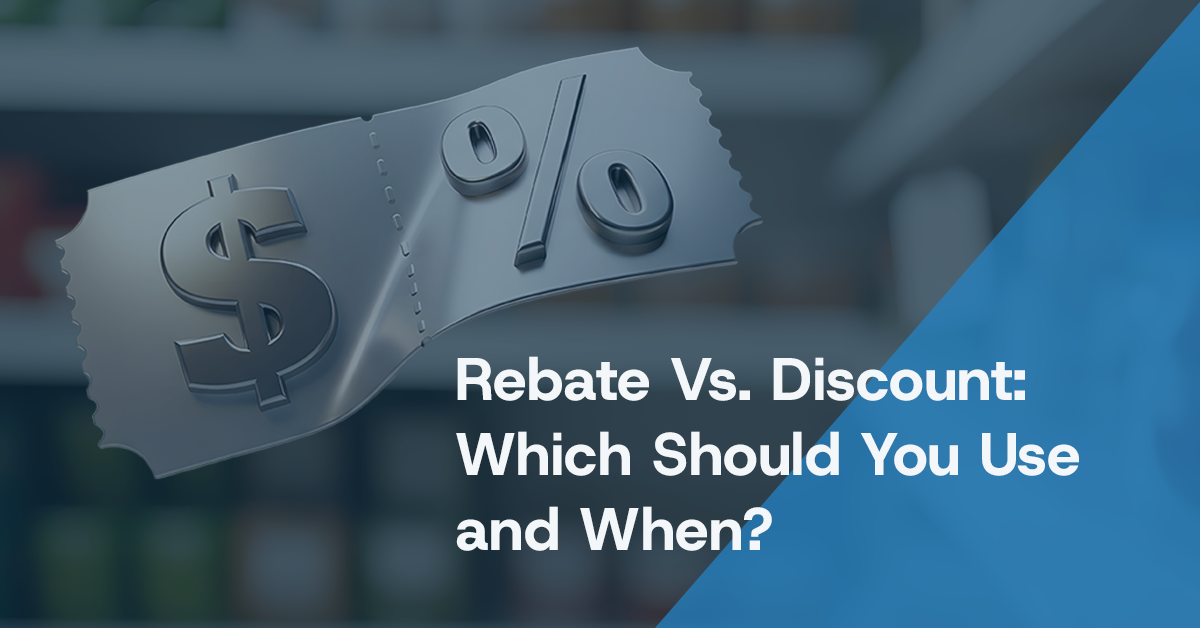
You are looking at a planning document, a new SKU launch, a promotional window, a price-sensitive category, and a trade budget that does not stretch as far as it used to. The question on the table: do you lower the price now and get sales moving, or do you offer money back after purchase and protect your margin?
Rebates and discounts are the two most direct ways to compete on price without permanently repositioning your brand. They feel similar from the outside. From a brand management and finance perspective, they operate very differently.
This guide compares the two mechanics across the dimensions that matter to a CPG marketer: cost structure, data capture, margin impact, and the specific campaign scenarios where each one earns its place in the plan.
The difference between a Rebate and a Discount
What is a Discount?
A discount is a reduction in the price paid at the point of purchase. The consumer sees a lower shelf price, a promotional tag, a coupon applied at checkout, or a BOGO mechanic, and pays less immediately. No further action is required.
CPG brands spend between 15% and 25% of gross sales on trade promotions annually, a significant share of which takes the form of temporary price reductions and promotional discounts. The appeal is straightforward: lower prices drive faster volume. The risk is equally straightforward: those lower prices are paid on every unit sold during the promotional period, including the volume that was going to sell anyway.
What is a Rebate?
A rebate is a post-purchase incentive. The consumer pays the full shelf price, completes a qualifying purchase, submits proof of that purchase (typically a receipt), and receives money back after the transaction is validated. The face value of the offer is the same as a discount, but the mechanics and economics are fundamentally different.
Because rebates require an active claim submission, not every consumer who buys during a rebate program actually redeems. Social Nature’s analysis of 133 digital rebate campaigns across CPG categories in 2024 found an average main offer redemption rate of 52%, rising to 55% when paired with offer overlays. The gap between purchases made and rebates claimed is what the industry calls slippage or breakage, and it is where rebates protect margin in a way discounts cannot.
Sources: Social Nature 2024 CPG Redemption Report — https://business.socialnature.com/redemption-rates-by-cpg-product-category/. Slippage / breakage definitions — Marketing literature, Wikipedia entry on Rebate (marketing).
A 10% discount costs the brand 10% on every unit sold. A 10% rebate costs the brand 10% on roughly half of qualifying purchases in the average CPG digital program — and generates verified purchase data on every one of those claims.
Rebate vs. Discount: Side-by-side
|
Dimension |
Discount |
Rebate |
|
When value is delivered |
Immediately at checkout |
After purchase, on claim submission |
|
Upfront budget cost |
100% of face value paid on every sale |
Only redeemed claims paid — typically ~50% in CPG digital programs |
|
Margin impact |
Permanent reduction on every unit sold |
Controllable — unredeemed rebates protect margin |
|
Purchase validation |
None — price is simply lower |
Receipt or proof-of-purchase required |
|
First-party data capture |
None |
Consumer identity, UPC, retailer, date, spend |
|
Fraud exposure |
Broad — anyone pays the lower price |
Lower — gated by submission and validation |
|
Targeting precision |
None — applies to all buyers |
High — distribute to specific segments via CRM or media |
|
Shelf price impact |
Shelf price is permanently reduced |
Shelf price stays intact |
|
Consumer friction |
Zero — savings are automatic |
Low-to-moderate — requires post-purchase step |
|
Brand perception |
Can train consumers to expect deals |
Post-purchase reward maintains perceived quality |
|
Best use case |
Impulse purchase, price match, inventory clear |
Trial, market defense, data capture, verified lift |
When to use each mechanic
When a Rebate is the right call
You need to protect shelf price while competing on value
When private label or a competitive brand moves into your category at a lower price point, cutting your shelf price is a response that is easy to make and hard to reverse. A rebate lets you deliver equivalent consumer value without touching the shelf tag. Loyal buyers continue to pay your full price. The rebate reaches the segment most at risk of switching, with an offer that has a defined budget and a defined end date.
You need verified data on who is actually buying
Every rebate submission generates a purchase record: consumer identity, UPC, retailer, transaction date, and spend. For CPG brands without direct data relationships with retailers, this is among the most reliable first-party purchase data available. A discount produces no equivalent data. You know sales volume went up during the promotional period. You do not know who bought, at which retailer, or whether the purchase was incremental.
You are launching a new product and need trial evidence
A rebate on a new SKU lowers the financial risk of trial for the consumer while preserving your full price position. More importantly, receipt validation confirms which consumers purchased, which gives you a clean dataset to measure trial rates, repeat purchase rates, and basket composition for the new product. That data directly informs the second campaign.
|
White Claw used this approach during March Madness with a program built specifically around the on-premise occasion. Consumers who purchased qualifying White Claw products at participating venues during the tournament could submit their receipt and receive cash back via Venmo, with a sweepstakes overlay for entries into a March Madness prize pool. The mechanic worked because it matched the consumer’s actual behavior in the moment: buying drinks at a sports bar, scrolling their phone between games, willing to take a 30-second action for a few dollars back. The receipt gave White Claw verified evidence of qualifying purchases at on-premise locations, a channel where brand sales data is notoriously difficult to obtain through traditional retailer reporting. |
Your finance team needs proof the promotion drove incremental sales
Rebate programs with a control group methodology produce the most defensible incrementality measurement available to CPG marketers. By comparing rebate participants against matched non-participants, brands can calculate lift above baseline, cost per incremental unit, and net ROI. A discount program produces none of this. More than 70% of global CPG trade promotion investments do not return their cost, a problem that is compounding pressure on marketing budgets. The brands that can prove their promotions work are the ones that get their budgets maintained.
When a Discount is the right call
You need to move volume fast and reach is the priority
When a brand is competing at shelf against a promotional feature from a competitor, or needs to accelerate trial of a new product during a limited window, the zero-friction nature of a discount is its primary asset. Consumers do not need to take any action after purchase. The saving is automatic. For brands where reach and immediate conversion matter more than measurement, a well-timed temporary price reduction is the faster tool.
The category is highly price-elastic and consumers are actively comparing shelf prices
In categories where shoppers routinely compare prices at shelf, such as commoditized grocery staples, beverages, or snacks where private label is strong, a visible shelf price gap can determine whether the product goes in the cart. A rebate requires the consumer to act after the fact. In a high-velocity, low-consideration purchase environment, that post-purchase friction may not be realistic.
You are clearing seasonal inventory or managing overstock
Inventory management promotions, where the goal is moving units within a defined window rather than building long-term consumer relationships, are well served by discounts. The economics are simple, the mechanic is fast to deploy, and the objective does not require the data infrastructure that makes rebates valuable.
|
Sun Pacific used this mechanic for Cuties during a key sales window at Kroger, where the goal was protecting and growing unit-level sales of fresh citrus during a period when consumers had multiple seasonal alternatives in the produce aisle. The program delivered a $5 off digital barcode after a quick online registration. Consumers signed up, received the barcode, and redeemed it on eligible items at Kroger checkout. There was no post-purchase step, no claim submission, and no waiting period. The simplicity was the point: the mechanic matched the speed of the produce purchase decision and the immediacy of the must-win window. |
The promotional mechanic needs to be visible at shelf
Rebates require consumer awareness and action that happens away from the point of purchase. Discounts are visible at shelf, in retailer circular features, and in digital retailer platforms at the moment the shopping decision is made. For campaigns where in-store visibility is the primary objective, discounts remain the simpler and more immediate tool.
Rebate vs. Coupon: A related distinction
If you are evaluating rebates and discounts, you are likely also considering coupons, since coupons are the most common CPG mechanic that sits between the two.
A coupon behaves more like a discount than a rebate: it reduces the price at or before purchase, requires no post-purchase action from the consumer, and generates no verified purchase data. The key structural difference is that a coupon is issued to a specific consumer or audience segment before purchase, while a discount is applied universally at shelf.
A rebate differs from both in one important respect: it validates the purchase after the fact. The consumer submits a receipt. The platform confirms what was bought, at which retailer, on which date. That verification step is what makes rebates useful for incrementality measurement and first-party data capture in a way that neither coupons nor shelf discounts can replicate.
For a detailed comparison of rebates and coupons specifically, including redemption rate benchmarks and measurement trade-offs, see our related guide: Digital Rebates vs. Coupons for CPG: Which Mechanic Drives More Incremental Lift?
How Snipp supports both mechanics
Snipp’s platform is designed to run rebate and discount programs separately or in combination, with a single integration point and a shared receipt validation and data capture infrastructure.
For rebate programs, Snipp handles the full program lifecycle: program design and configuration, receipt processing and UPC-level validation, fraud detection and prevention, digital reward fulfillment (virtual Visa, Venmo, gift cards, and more), and real-time reporting on submission rates, validation rates, and payout status. Programs can be configured as single-purchase rebates, multi-purchase threshold mechanics, portfolio-level cashback offers, or B2B channel rebates.
For coupon and discount programs, Snipp’s Offers platform manages digital barcode offer creation, distribution through paid, owned, and earned media channels, and redemption tracking at 50+ U.S. retail banners. Offers can be validated via POS integration or receipt submission, with the receipt path providing purchase-level data even on coupon-led programs.
The two mechanics can run simultaneously on a single platform. A program that issues a digital coupon to drive trial and uses receipt submission to unlock a sweepstakes entry, for example, generates both the reach of a coupon and the purchase verification of a receipt-based program within a single consumer journey.
Frequently Asked Questions
What is the difference between a rebate and a discount?
A discount reduces the price at the point of purchase. The consumer pays less immediately, with no further action required. A rebate pays out after purchase, triggered by a validated claim submission. The face value of the offer can be identical, but the cost structure, data output, and margin impact differ significantly. Discounts are paid on every unit sold during the promotional period. Rebates are paid only on validated claims. Social Nature’s analysis of 133 digital CPG rebate campaigns found an average redemption rate of 52%, meaning roughly half of qualifying purchases convert to a payout.
Is a rebate better than a discount for a CPG brand?
It depends on the campaign objective. Rebates are typically more cost-efficient than equivalent discounts because not all consumers complete the redemption process — a phenomenon known as slippage or breakage. The unredeemed portion of the rebate pool protects margin in a way a universal discount cannot. Rebates also generate verified first-party purchase data that discounts do not. Discounts, on the other hand, are simpler to execute, produce zero consumer friction, and work better in high-velocity, price-elastic categories where shelf visibility is the priority. Neither is universally better: the right choice is determined by what the campaign needs to prove and who it needs to reach.
Is a rebate better than a discount for a CPG brand?
It depends on the campaign objective. Rebates are typically more cost-efficient than equivalent discounts because not all consumers complete the redemption process — a phenomenon known as slippage or breakage. The unredeemed portion of the rebate pool protects margin in a way a universal discount cannot. Rebates also generate verified first-party purchase data that discounts do not. Discounts, on the other hand, are simpler to execute, produce zero consumer friction, and work better in high-velocity, price-elastic categories where shelf visibility is the priority. Neither is universally better: the right choice is determined by what the campaign needs to prove and who it needs to reach.
When do CPG brands use rebates instead of discounts?
CPG brands typically use rebates when one or more of the following conditions apply: they need to protect shelf price while still competing on value; they need to generate verified first-party consumer and purchase data; they are trying to prove incremental lift to finance with defensible measurement; they want to limit offer access to specific consumer segments rather than discounting universally; or they are in a regulated category or geography where certain discount mechanics have compliance constraints. Discounts are more common when the objective is speed-to-shelf, broad reach, or inventory management where measurement precision is secondary to volume.
Not sure which mechanic fits your next campaign? Snipp’s CPG specialists help brands choose, design, and run rebate and discount programs that prove performance. Contact us to Talk to a Specialist
Subscribe for updates straight to your inbox