Promotion and loyalty fraud is not a minor line item. According to Inmar Intelligence, brands lose an estimated $100 billion annually to coupon and promotion fraud globally. For every campaign that runs without proper receipt verification, a portion of that budget is funding fraudulent claims rather than rewarding real customers.
If your team is running rebate programs, receipt-based promotions, or purchase-validation campaigns, the question is not whether fraud is happening. It is how much of it you can detect and prevent before it erodes your ROI.
This post explains how receipt verification works, how modern platforms detect fake and manipulated receipts, and what brands need to look for in a verification partner.
Key Takeaways
- Receipt verification is the process of confirming that a consumer's purchase claim is real, complete, and eligible, without requiring a direct POS integration.
- Modern AI-powered verification catches manipulated images, duplicate submissions, and synthetic receipts that pass basic visual checks.
- Receipt verification runs without POS integration, making it deployable across retail channels, markets, and product categories with minimal setup.
- Snipp's receipt processing and validation platform combines OCR, machine learning, and human review to deliver scalable, accurate purchase validation across brand programs globally.
What is Receipt Verification?
Receipt verification is the process of authenticating consumer purchase claims by reviewing submitted receipts to confirm that a qualifying product was purchased, at an eligible retailer, within the promotion window. Powered by automated optical character recognition (OCR) software, it scans receipts to pinpoint key information to validate purchases. Verification checks for authenticity, completeness, and eligibility, not just that an image was uploaded.
The term is sometimes used interchangeably with receipt validation, but they refer to related, distinct functions. Validation confirms that a receipt meets the technical rules of a promotion (correct product, correct date, correct store). Verification is the broader process of confirming that the receipt itself is real and has not been falsified, duplicated, or digitally altered.
Together, they form the backbone of any credible purchase-based promotion, rebate or loyalty program.
As a by-product, receipt verification technology collects retailer-agnostic, first-party customer data without needing to connect to point of sale (POS) systems. You can then harness this data to support future marketing campaigns.
How Does it Work?
To better understand how receipt validation technology works, let’s take a closer look at Snipps receipt processing platform,
Snipp supports brand promotions and programs across the entire path to purchase. This includes everything from simple gift-with-purchase and instant-win promotions to giveaways and multi-tiered loyalty programs.
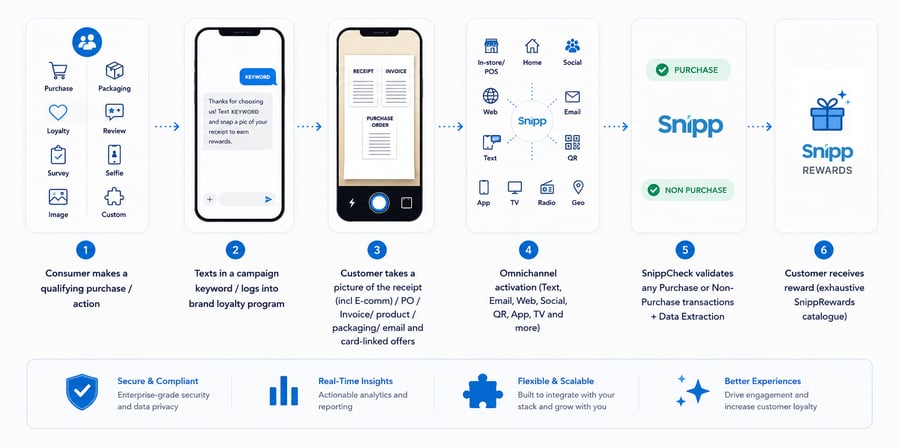
Snipp’s receipt verification process follows a simple, six-stage process:
- Purchase: The customer makes a qualifying purchase (any product that belongs to a specific promotion, campaign, or program).
- Entry: The customer texts the promotion/campaign keyword or logs into your promotion or loyalty program.
- Proof: The customer takes a picture of their receipt, invoice, or purchase order.
- Activation. The customer submits the picture via their preferred engagement channel (e.g., text, email, web, app).
- Validation and verification : Our receipt validation technology analyzes the receipt to validate the transaction and collect shopper data (e.g., date of purchase, store, basket share, and total spend) as well as verification for receipt authenticity
- Reward: Once our platform validates the purchase, the customer receives their reward from Snipp’s extensive rewards catalog.
Why Receipt Verification Matters to Brand Marketers
For shopper marketing managers and promotion operations teams, the cost of weak verification shows up in two ways: financial leakage from fraudulent reimbursements and reputational damage when legitimate customers face delays or inconsistent claim decisions.
Promotion and marketing leaders running large-scale rebate or proof-of-purchase programs face growing pressure from finance teams to demonstrate ROI. When fraud goes undetected, reported program results look stronger than they are, which creates budget misallocation and poor campaign decisions downstream.
According to a Vericast consumer research report, 58% of consumers say a poor promotional experience damages their perception of a brand. Inconsistent claim decisions, the kind that result from manual or incomplete verification, directly affect that perception.
|
"The average promotion fraud rate for consumer packaged goods brands ranges from 3% to 15% of total redemptions, with digital channels increasingly targeted by organized fraud rings." Promotion Industry Benchmark, Association of Coupon Professionals |
How Receipt Verification Works
Modern receipt verification combines optical character recognition (OCR), artificial intelligence, and rules-based validation logic to process submitted receipts accurately and at scale. The process works without requiring access to a retailer's point-of-sale system, which means brands can run programs across any retail channel with minimal technical setup.
For a deeper look at the technology layer, see Snipp's Receipt Processing and Validation solution sheet.
Step 1: Receipt Submission
Consumers submit receipts through a brand's chosen channel: a microsite, mobile app, SMS, or retailer-hosted portal. Snipp's platform accepts receipts in multiple formats, including JPG, PNG, and PDF, and supports e-receipts and email-forwarded receipts alongside physical paper uploads.
At the point of submission, the platform begins a first-pass integrity check, reviewing file metadata, resolution, and format before it reaches OCR processing. Submissions that fail basic quality thresholds are flagged immediately.
Step 2: OCR Extraction and Data Parsing (receipt processing)
Once a receipt passes the initial intake check, OCR technology extracts structured data from the image: retailer name, date and time, line items, quantities, prices, and payment method. This extracted data becomes the basis for all downstream verification decisions.
Snipp's OCR layer is trained on thousands of retailer formats across North America, Europe, and global markets, which improves accuracy on non-standard receipt layouts, handwritten annotations, and low-resolution images.
Step 3: Eligibility Validation (receipt validation)
With parsed data in hand, the platform checks each claim against the program's eligibility rules: Does the product match the qualifying SKU list? Is the purchase date within the promotion window? Does the retailer qualify? Was the correct quantity purchased? Validation rules are configured per campaign and can be updated without technical intervention.
Learn more about how Snipp's Receipt Processing platform handles eligibility logic across complex, multi-SKU programs.
Step 4: Fraud Detection Scoring (receipt verification)
Simultaneously, the platform runs the receipt through a fraud scoring model. Each submission receives a risk score based on signals including duplicate detection, image manipulation analysis, velocity patterns (multiple claims from the same device, email, or address), and cross-program abuse patterns.
High-risk submissions are routed for human review. Low-risk submissions move to approval. This hybrid approach allows high-volume programs to process thousands of submissions daily without sacrificing accuracy.
Step 5: Decision and Consumer Communication
Approved claims are queued for fulfillment: cashback, prepaid card, product reward, or other incentive. Rejected or flagged claims trigger a consumer communication workflow, which can include a request for resubmission, an explanation of the rejection reason, or escalation for additional review.
Consistent, transparent communication at this stage is critical for consumer experience. Programs with clear, prompt claim decisions generate significantly higher consumer satisfaction scores than those with opaque or delayed responses.
Detecting Fraudulent and AI-Generated Receipts
Receipt fraud has evolved. Basic attempts to reuse an old receipt or submit a hand-edited image are now only a fraction of the problem. With AI image-generation tools widely accessible, bad actors are producing synthetic receipts that are visually indistinguishable from authentic ones. Organized fraud rings submit thousands of claims from coordinated networks of consumer accounts, making volume-based detection alone insufficient.
Snipp's Corral Fraud Detection and Prevention capability is built to address both opportunistic and organized fraud at the image, data, and behavioral level.
1. Image Integrity Analysis
The platform analyzes receipt images for signs of digital manipulation: pixel-level inconsistencies, metadata mismatches between image creation date and receipt date, font rendering anomalies that indicate text has been inserted or modified, and shadow or lighting inconsistencies that suggest compositing.
AI-generated receipts often pass a visual check but fail at the metadata and font-rendering layer. Snipp's detection models are continuously updated as generation techniques evolve.
2. Duplicate and Cross-Campaign Detection
Each receipt submitted to the Snipp platform is hashed and checked against a cross-program database of previously processed receipts. This catches straightforward duplicate submissions as well as more sophisticated attempts to resubmit modified images of the same receipt across different promotions or consumer accounts.
Cross-campaign duplicate detection is particularly important for brands running concurrent programs across multiple markets or product lines.
3. Behavioral and Velocity Signals
Device fingerprinting, IP address analysis, account-level velocity checks, and address clustering are layered on top of image-level checks. A claim submitted from a device that has already filed 50 claims across various programs triggers a risk flag regardless of whether the receipt image looks authentic.
These behavioral signals are especially effective against organized fraud rings, where individual receipts may appear legitimate but the submission pattern is anomalous.
4. Human Review and Escalation
Automated scoring handles the large majority of submissions. Claims that score above a defined risk threshold are routed to Snipp's human review team for manual adjudication. This escalation layer ensures that edge cases, emerging fraud patterns, and borderline submissions receive appropriate scrutiny before a final decision is issued.
Receipt Verification Without POS Integration
One of the most common questions from brands evaluating receipt-based promotion platforms is whether a direct integration with retailer point-of-sale systems is required. It is not.
Snipp's platform operates entirely on the submitted receipt image and extracted data, with no dependency on retailer POS access. This architecture has several practical advantages:
- Programs can launch across any retailer, from national chains to independent stores, without negotiating data-sharing agreements.
- Campaign timelines are not dependent on retailer IT readiness or data feed availability.
- Multi-retailer programs can be managed under a single verification workflow with consistent rules applied across all channels.
- Global programs covering markets with limited retailer data infrastructure can still operate with reliable verification.
This matters most for brands running national or international promotions where standardizing a POS integration across hundreds of retail partners would be impractical or cost-prohibitive.
Examples of Receipt Validation in Action
Nescafé Instant Win + Sweepstakes Promotion
Nescafe created an exciting, multi-layered program that rewarded participants for capturing the moments that matter. Customers who bought qualifying Nescafe products could upload a picture of their receipt to participate in a custom Polaroid game for the chance to win cash prizes and enter their name into a $50,000 grand prize sweepstakes draw. The Get Rich Quick promotion helped to boost engagement and drive sales.
IKO Industries: B2B Receipt/ Invoice-Based Incentives
Snipp's verification capabilities extend beyond consumer promotions. IKO Industries used Snipp's platform to validate purchase claims within a trade loyalty program, demonstrating that receipt verification infrastructure is equally applicable to B2B incentive programs where purchase validation is required at a distributor or contractor level. The program is increasing contractor and distributor satisfaction.
Pringles Multi-country Receipt Campaign
Kellogg’s Pringles harnessed our receipt validation technology to power an innovative multi-national promotion. Available in Bahrain, Kuwait, Oman, Saudi Arabia, and the UAE, the promotion leverages the brand’s partnership with La Liga, giving customers the chance to win a kick around with soccer superstar and former Spain striker David Villa. Customers simply purchase a qualifying product and submit a copy of their receipt to the promotion website for a chance to win. The promotion is helping to drive Pringles sales across the MENAT region.
Frequently Asked Questions
What is receipt verification?
Receipt verification is the process of confirming that a consumer's purchase claim is legitimate. It involves reviewing a submitted receipt image to extract purchase data, check eligibility against promotion rules, and assess whether the receipt is authentic and has not been altered or duplicated. Verification is broader than validation: validation checks eligibility rules, while verification confirms the receipt itself is real.
How does receipt verification work without POS integration?
Receipt verification platforms like Snipp's operate on the data extracted from the receipt image itself using OCR and AI. No connection to a retailer's point-of-sale system is needed. The platform reads the receipt, extracts product, price, date, and retailer data, and checks it against the program's eligibility criteria and fraud detection models. This makes it deployable across any retailer or channel without technical dependencies on retail infrastructure.
Modern verification platforms use multiple detection layers. Image integrity analysis checks for pixel inconsistencies, metadata mismatches, and font anomalies that indicate manipulation or AI generation. Duplicate detection hashes each receipt image and checks it against a cross-program database. Behavioral signals, including device fingerprinting, IP analysis, and submission velocity checks, catch organized fraud patterns that individual image analysis might miss. High-risk submissions are escalated to human review before a final decision is issued.
What's Next
If receipt fraud or inefficient claim verification is affecting your promotion programs, these resources will help you go deeper:
Keep learning: The ROI on Receipts: 10 Brand Objectives You Can Achieve with Receipt Programs
Read the solution sheet: Snipp Receipt Processing and Validation
Explore the platform: Snipp Receipt Processing and Fraud Detection and Prevention
If you're ready to see the platform in action, and a Snipp specialist will walk you through it
Stay connected: subscribe to the Snipp newsletter for the latest in promotions, loyalty, and purchase validation.
See Receipt Verification in Action
Snipp processes millions of receipts annually for global brands across CPG, beverage alcohol, healthcare, and home improvement. Request a personalized demo to see how the platform handles your category and campaign structure. request a demo

Subscribe for updates straight to your inbox