CPG marketing managers deal with a version of the same problem every planning cycle: how much of the promotional spend actually changed consumer behavior, and how much of it just made the purchase cheaper for people who were going to buy anyway. The gap between those two things is the gap between a program worth repeating and one worth cutting.
Digital coupons and digital rebates both show up in the answer to that question, but they produce very different evidence. Both mechanics deliver value to the consumer. Both drive redemptions. Where they diverge is in how much a brand can actually learn from those redemptions, and how confidently it can tie spend to net new sales.
Snipp's March 2026 survey of 1,000 U.S. grocery shoppers found that 43.7% of shoppers plan to actively seek out more discounts and promotions as household budgets stay under pressure. That demand is real. The question worth spending time on is which mechanic captures it in a way that generates proof, not just volume.
What incremental lift actually means
Incremental lift is the sales volume generated above what would have happened without a promotion. The calculation looks simple:
Incremental lift = Promotional period sales − Baseline sales − Post-promo dip
The post-promo dip is easy to miss but important. When consumers stock up during a promotion, some of that volume is just future purchases moved forward. It shows up as a sales spike during the campaign and a sales drag in the weeks after, without generating any meaningful revenue above what would have accrued over a longer window.
The harder measurement problem is sorting out which buyers the promotion actually influenced. Any promotional campaign reaches a mix of consumers. Some were never going to buy without an offer. Some were buying in the category regardless but chose your brand specifically because of the deal. And some were going to buy your product at full price and simply benefited from a discount they would have bought without. That last group is subsidized volume, and it is present in every promotion to some degree. The question is how large that proportion is, and whether the mechanic gives you any visibility into it.
A program that moves a lot of volume but cannot tell you how much of it was incremental is a program you cannot defend in the next budget conversation.
Digital coupons: Where they work and where they don't
The mechanics
A digital coupon reduces the price at checkout through a barcode, QR code, or promo code. The consumer receives the saving before completing the transaction, which is what makes coupons fast and frictionless to redeem. In 2025, 169.2 million Americans redeemed digital coupons, and the average digital coupon redemption rate sits at 5.92%, roughly ten times what paper alternatives typically achieve. For getting a new product in front of a broad audience quickly, coupons are hard to beat on reach.
The measurement gap
The core problem with coupons and incrementality measurement is that there is no purchase validation. The brand knows the code was used. It does not know whether the buyer was new to the product or had been buying it for years, whether the right product was purchased, or whether the transaction would have happened at full price. The retailer records a discounted sale. The brand gets a redemption count and not much else.
When a coupon is distributed broadly, through email lists, retailer platforms, or coupon aggregator sites, most redemptions tend to come from existing buyers. Research on CPG trade promotions consistently shows that a large share of promoted volume represents purchases that would have occurred at full price without the offer. Broadly distributed coupons without any audience segmentation skew toward that outcome.
Fraud and misredemption
Generic, shareable promo codes compound the measurement problem. Once a code appears on a coupon aggregator site or circulates on social media, it gets used by consumers who were never the intended audience, on products that may not qualify, through channels the brand never planned for. Redemption volume goes up. Data quality goes down. The signal-to-noise ratio in the post-campaign analysis becomes difficult to work with.
Single-use unique codes solve the fraud exposure but add distribution complexity and reduce the organic reach that comes from codes being shared through social channels.
Digital rebates: The purchase validation advantage
The mechanics
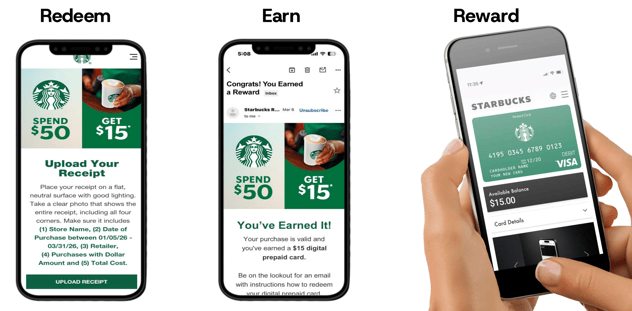
A digital rebate or cashback pays out after purchase, not before. The consumer buys the qualifying product, photographs their receipt, submits it through the program platform, and receives payment once the purchase is validated at the UPC level. The payout comes via Venmo, virtual Visa, digital gift card, or similar method.
That post-purchase step is the structural difference that matters. Every payout is tied to a confirmed transaction, at a specific retailer, for a specific product, on a specific date. The brand has purchase-level data on every consumer who redeems.
Why rebates skew more incremental
Requiring a receipt submission creates a natural filter. A consumer who was going to buy the product anyway, at any price, is less likely to complete the post-purchase submission process unless the rebate value is meaningful enough to justify the effort. The self-selection that results tends to draw more strongly motivated buyers, which in practice means a higher proportion of consumers for whom the offer actually influenced the purchase decision.
More importantly, the receipt data makes it possible to measure lift directly. By comparing rebate participants to a matched control group of similar consumers who did not receive the offer, brands can calculate the true incremental volume the program generated. That closed-loop measurement is what finance teams need to evaluate whether a program performed, and it is what coupon-only programs typically cannot produce.
Targeting
Rebates can be delivered to specific consumer segments based on CRM data, purchase history, or behavioral triggers. A rebate offer distributed specifically to lapsed buyers, consumers who purchased six or more months ago and have not returned, reaches a segment where the probability of incremental purchase is high. Sending that same offer to loyal weekly buyers reaches a segment where the probability of subsidy is high. The mechanic is identical; the targeting determines whether it generates lift or just discounts the base.
Getting this right requires CRM integration, a segmentation capability, and a rebate platform that can distribute personalized offers by audience and channel. When those pieces are in place, the incremental buyer proportion in the redemption pool tends to be substantially higher than in a broadly distributed coupon campaign.
|
5.92% |
Average digital coupon redemption rate (up 12.8% from 2023), applied to all buyers regardless of whether the offer influenced their decision |
|
39.3% |
U.S. grocery shoppers who increased coupon and loyalty program usage in response to economic pressure |
|
~64% |
Proportion of promoted CPG sales that represent subsidized baseline volume in a typical broadly-distributed promotion (CPG Data Insights) |
The head-to-head
|
Dimension |
Digital Coupon |
Digital Rebate |
|
When value is delivered |
At point of purchase (before) |
After purchase (post-validation) |
|
Purchase verification |
None - code entry only |
Receipt-based SKU validation |
|
Fraud exposure |
High - codes shared, stacked, leaked |
Low - unique per submission, receipt-gated |
|
Baseline buyer subsidy |
High - all buyers, any channel |
Lower - targetable to specific segments |
|
First-party data capture |
Minimal (channel only) |
Rich: who, what, where, when, price |
|
Incremental lift measurement |
Difficult - no purchase proof |
Direct - validated purchase event |
|
Retailer dependency |
Often requires retailer integration |
Retailer-agnostic via receipt processing |
|
Consumer excitement / UX |
High - instant gratification |
Moderate - requires post-purchase step |
|
Targeting precision |
Moderate - broadly distributed |
High - CRM, CDP, media segmentation |
|
Best use case |
Trial, broad awareness, impulse |
Verified lift, market defense, data capture |
The mechanics in practice
When a coupon makes sense: Driving trial volume
If the goal is getting a product into new hands as fast as possible, a coupon is well-suited to the task. The pre-purchase value removes the price barrier at the moment the consumer is making a decision, and broad distribution means reaching a large audience without requiring any prior brand relationship.
The measurement trade-off is real but manageable if you plan for it. Layering a receipt submission mechanic on top of the coupon, as Snipp did with the DiGiorno game day program where receipt uploads unlocked additional sweepstakes entries, adds a partial purchase validation layer to an otherwise coupon-led program. You will not get the same measurement fidelity as a rebate, but you will get more signal than a standalone coupon redemption count.
|
Nestlé DiGiorno: Digital Coupon + Sweepstakes Driving trial and sales velocity during game day season. DiGiorno ran a game-day coupon program where registration unlocked a $2 off digital barcode on any two pizzas. In addition, all registrants were entered into weekly sweepstakes for game day prizes, with additional entries earned through receipt submission after purchase. The added receipt submission step was what gave the coupon-led program its measurement value with every submission confirming a qualifying purchase and generated the retailer and SKU-level data |
When a rebate makes sense: Verified lift
If the goal is generating evidence that the program drove net new sales, a rebate is the right mechanic. Every submission creates a purchase record. With a properly structured control group, the brand can calculate the incremental units sold above baseline and the cost per incremental unit. That is the number finance teams need, and a coupon program typically cannot produce it.
The trade-off is friction. Some consumers who would respond to a coupon will not complete a receipt submission. That is acceptable if the objective is measurement quality, because the consumers who do complete the submission are more likely to represent genuinely incremental purchases.
|
Kellanova: Fall Football Cashback In-store sales lift with receipt-validated cash back promotion. Kellanova ran a Fall Football cash back program on Snipp’s platform where consumers who spent $15 or more on participating products could upload their receipt to receive a $5 digital reward. Every qualifying submission produced a verified purchase record of product, spend, retailer, date without relying on any retailer data-sharing arrangement. |
Choosing the right mechanic
The decision comes down to what the campaign needs to prove and who it needs to reach. Neither mechanic is universally superior. Coupons are better for some objectives; rebates are better for others.
|
Campaign Goal |
Best Mechanic |
Why |
|
Drive broad trial of a new SKU quickly |
Coupon |
Low barrier, pre-purchase value, wide distribution |
|
Prove incremental lift to finance |
Rebate |
Receipt validation provides verified purchase data |
|
Defend against private label price pressure |
Rebate |
Protects shelf price; targets at-risk segments |
|
Build first-party consumer data |
Rebate |
Every submission = a purchase-verified profile |
|
Drive repeat purchase and habit formation |
Rebate |
Multi-purchase mechanics create earned reward loop |
|
Maximum reach across budget-conscious shoppers |
Coupon |
Pre-purchase value appeals to immediate savers |
|
Run a national program across all retail banners |
Rebate |
Receipt-based; no retailer agreement required |
|
Reduce fraud and misredemption exposure |
Rebate |
Unique per-submission; receipt-gated; AI fraud detection |
|
Increase basket size across SKUs |
Rebate |
Multi-product purchase threshold mechanics |
|
Comply with state regulations (alcohol, etc.) |
Rebate + Sweeps |
State routing handles non-rebate jurisdictions automatically |
Some of the strongest CPG programs run both mechanics simultaneously through a single submission flow. A pre-purchase coupon gets the consumer to buy. A receipt submission after purchase unlocks a sweepstakes entry or additional rebate value. The result is trial-driving reach from the coupon and purchase-validated data from the receipt, without requiring the consumer to navigate two separate programs.
The measurement problem both mechanics share
71% of CPG marketers now rate incrementality as their most important KPI for promotional investment, but a third of them acknowledge they are only measuring it at a basic level. The gap between what marketers want to know and what their programs actually measure is where most promotional budget leaks.
A coupon program with 500,000 redemptions and no purchase data cannot tell you how many of those redemptions changed a purchasing decision. A rebate program with 200,000 validated submissions and a matched control group showing 34% lift above baseline can. The second program is smaller in volume and stronger in evidence, and over time it is the one that gets a budget allocation justified and increased.
Coupons are optimized for reach. Rebates are optimized for measurement. Brands that need both tend to design programs that layer them, using the coupon to drive volume and the receipt validation step to generate the data that justifies the spend.
Redemption count is what the platform reports. Incremental lift per promotional dollar is what your finance team is asking for. Rebates generate the data to bridge that gap.
Closing thoughts
CPG brands are not short of promotional mechanics. What most of them are short of is confidence that those mechanics are generating net new sales rather than just discounting the purchases that were already going to happen.
Digital coupons are fast, accessible, and well-suited to trial and awareness objectives where reach matters more than measurement precision. Digital rebates generate the purchase-level data that makes it possible to answer the incrementality question with real confidence. The best programs tend to use both, in the right sequence, for the right audience.
As household budgets stay tight and shoppers actively hunt for value, the promotional opportunity is genuine. How you structure the program determines whether you can prove you captured it.
See how Snipp designs coupon and rebate programs for CPG brands that prove incremental lift.
Talk to a CPG specialist about the right mechanic for your next campaign. Request a Demo
FAQs
Q1: What's the difference between a digital coupon and a digital rebate in CPG?
A digital coupon reduces the price at the point of purchase. The consumer scans a barcode or enters a code at checkout and pays less immediately. A digital rebate pays out after purchase, triggered by a verified receipt submission. The practical difference for CPG brands is data and measurement: coupons tell you a code was used whereas rebates tell you exactly what was purchased, where, by whom, and when.
Snipp supports both mechanics:
Digital coupon management with 50+ US retail banner digital barcode connectivity
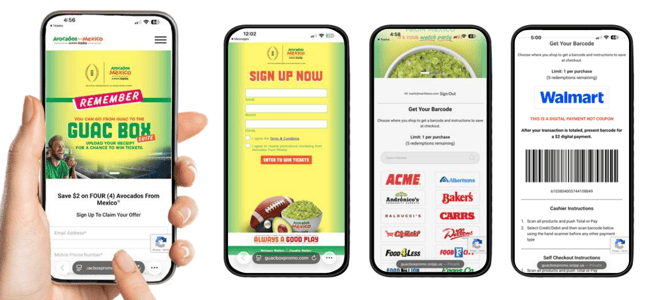
Retail agnostic Digital Rebates for receipt-validated cashback programs.
Q2: Can I run a rebate across all retailers, or do I need separate agreements with each one?
You do not need retailer agreements and can be run without a POS integration or bilateral data agreement at each banner. Snipp's rebate programs are retailer-agnostic by design. Consumers can purchase at any store, a regional grocery banner, or an independent retailer and validate their purchase by uploading a photo of their receipt.
Q3: How do you measure incremental lift from a rebate program?
The receipt submission creates the data foundation for incrementality analysis. Every validated submission generates a confirmed purchase record by product, quantity, retailer, date, and spend. By comparing rebate participants against a matched control group of similar consumers who did not receive the offer, brands can calculate the difference in purchase rates between the two groups. That delta is the incremental lift the program generated.
Q4: Can Snipp combine a digital coupon and a rebate in a single program?
Yes. Snipp's platform supports combined mechanics through a single consumer-facing flow. A pre-purchase digital coupon drives the initial trial decision; a post-purchase receipt submission validates the qualifying buy and triggers either a rebate payout, a sweepstakes entry, or both.
Subscribe for updates straight to your inbox