Once upon a time, loyalty marketing ran on gut instinct and Excel.
Then came CRMs and basic segmentation tools that allowed brands to create generic promotions for broad customer segments. But today’s consumers don’t follow tidy, linear paths. Their journeys crisscross apps, stores, websites, and social channels -- often within minutes. To keep up, brands need more than static rules and analytics that only answer the questions you already know to ask (Which customers made a purchase in the last 30 days? What’s our average basket size by region?).
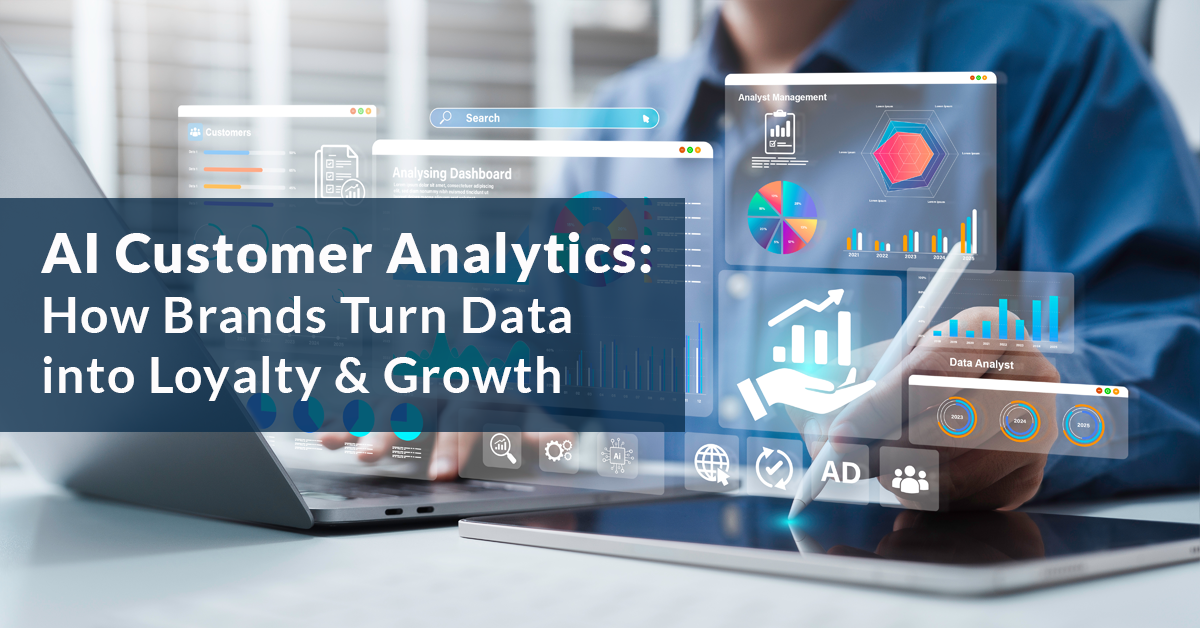
AI is changing the game. It uncovers hidden patterns, predicts future behavior, and responds faster than human teams can. Building on decades of data infrastructure, AI consumer insights draws from loyalty program activity, purchase history, browsing habits, personal preferences, app usage, geolocation, and social signals to create a live, evolving view of each customer. And it continuously adapts based on real-time behavior, improving its accuracy over time. The result: better data, smarter targeting, faster responses, lower acquisition costs – and a loyalty engine that never stops learning.
From Gut Feel To Predictive Precision
|
Analytics Era |
Typical Data & Signals |
What Marketers Could Do (then) |
Core Limitation |
|
Early CRM (2000s) |
Basic contact details and purchase records |
Send one-size-fits-all-post-purchase messages to the full list |
Manual, siloed, and purely reactive |
|
Rules-Based Segmentation (2010s) |
Demographics and broad market segments defined at campaign planning time |
Slot customers into Silver/Gold tiers and run broad, mass-media promotions to each segment |
Static groupings; little nuance beyond age or income |
|
Predictive (late 2010s) |
Propensity scores, churn likelihood from transaction data |
Target customers most likely to buy or lapse based on modelled scores |
Insightful but slow: one-way communication |
|
AI-Powered (Today) |
Real-time POS, apps, geo-signals, sentiment data; continuously learned and combined |
Auto-adjust offers, content, and timing based on live behavior –guiding each customer through a 1:1 journey from first touchpoint to reward. |
Fewer technical limits, but success hinges on data quality, governance, and talent |
Five Ways AI is Reinventing Customer Analytics
1. Smarter Segmentation & Optimized Recommendations:
AI moves segmentation beyond basic demographics. It identifies micro-communities based on actual behavior, e.g. "new puppy parents in cold climates who buy monthly" instead of just "urban millennials." These profiles are continuously enriched with every interaction, and the segments they form are updated in real time to reflect shifting behaviors, preferences, and intent. AI can also run A/B tests on the fly, optimizing redemption rates and campaign timing for every cohort. According to McKinsey, 65% of shoppers say personalized promotions influence purchases, and AI-driven campaigns targeting micro-segments can lift sales 1 – 2% and improve margins 1 – 3%.
Kellogg’s × Snipp: Snipp’s AI-powered instant win gamification campaign helped Kellogg’s gather registration, engagement, and real-time redemption data. This allowed the system to better understand their audience for re-targeting purposes, and to optimize future promotions and redemption strategies.
McDonald’s × Dynamic Yield: McDonald’s uses its AI platform to A/B test and regularly optimize menu suggestions for its drive-thru and in-store kiosks based on weather, time, and location pings. These dynamically adjusted offers have lifted sales by over 10% in test markets and generated incremental average check sizes.
2. Real-Time, Point-of-Sale Engagement
AI can optimize the final touchpoint -- right at the moment of purchase, when intent peaks. As a customer pays, AI calculates the perfect next incentive, e.g. "Add socks now and your shipping is free", increasing conversion and cross-sell opportunities.
Macy’s + Rokt: After checkout, Macy’s serves third-party partner offers -- like magazine subscriptions or streaming service deals – chosen from five billion transaction signals. The retailer weaves these personalized “non-endemic” coupons into every online receipt, so each customer sees a promotion tailored to their interests. The result is above-average engagement, incremental media revenue, and clear value-add.
3. Predictive Modeling – and Proactive Service:
AI analyzes historical data to predict future customer behavior, flag churn risks, and address problems before they arise. These models continuously learn from new inputs, becoming increasingly accurate and responsive. This also powers automated content personalization – delivering dynamic, AI-tailored messages, offers, and rewards aligned with each customer’s real-time context and intent.

Spotify: Spotify leverages user data and machine learning algorithms to analyze music preferences, search behavior, playlist data, and device usage to serve hyper-personalized playlists to customers. The system examines audio features like tempo, key, and harmony to understand musical elements that contribute to user preferences, adapting and growing with their tastes. This predictive capability helped scale their user base from 75M monthly active users in 2015 to over 675M by 2024 – and keeps them coming back.
4. Accelerating Response Times with AI Chatbots:
The rise of real-time chatbots has transformed customer service, offering instant, AI-driven interactions that eliminate the need for human intervention in many cases. These systems can handle routine inquiries, process simple transactions, and gather initial information before escalating complex issues to human agents. According to Tidio, 82% of customers will talk to a chatbot if it means avoiding wait times with human representatives. Through the use of chatbots, around 90% of customer queries are resolved in fewer than 11 messages. Businesses save up to 30% on customer support costs while also boosting customer satisfaction. The average ROI from support cost savings alone is 1,275%.
Walmart: Walmart has embraced AI-powered chatbots to streamline tasks like order tracking and returns processing across multiple regions and languages. Since implementing these AI systems in 2020, Walmart has reduced customer service calls while seeing customer satisfaction scores increase around 38% through faster, more efficient service.
Virgin Money's Redi: Virgin Money's AI-powered conversational assistant, accessible through the bank's mobile app, has had more than 2 million interactions with customers, handling routine banking inquiries, account information requests, and basic transaction support. The chatbot maintains a 94% customer satisfaction rate among surveyed users.
5. Intelligent Human + AI Partnerships in Customer Service:
AI systems now manage routine tasks, only routing queries to human agents when empathy or complex problem-solving is required. By using sentiment analysis, AI can detect signs of frustration or urgency across feedback channels -- even social media -- and either alert a specialized human agent or trigger a personalized message or offer to retain the customer. McKinsey refers to this as "empathy at scale", an approach that is proving highly effective: 79% of agents say AI improves their performance, and companies report up to a 17% increase in customer satisfaction according to Zendesk’s 2025 Trends report.
Bank of America's Erica: Erica, Bank of America’s AI assistant, leverages machine learning to predict customer needs, notify users about upcoming bills, and provide tailored financial advice to clients. It handles everyday banking requests and offers proactive nudges – but more complex issues are escalated to human agents. The system has processed over 2.5 billion interactions, serving more than 20 million users contributing to their digital-leaning relationship strategy.

TrueLayer's Ema: TrueLayer, a fintech pioneer in the UK and EU, has deployed an AI agent named Ema to automate a majority of its customer support tasks. Ema resolves more than 80% of incoming cases, identifies which ones need human attention, and provides support to agents during those escalations. This model enables the team to focus resources on higher-complexity requests while maintaining responsiveness across channels.
What's Next: Agentic Ai Takes The Wheel
AI is evolving from a responsive tool to a proactive agent. In 2025, we’re likely to see a surge in "Agentic AI" systems that plan, reason, and act on their own. Unlike today’s chatbots and AI co-pilots, which rely on human users to steer the conversation or workflow, agentic AI has true "agency" – it’s designed to interpret high-level goals, determine the necessary steps to achieve them, and take independent initiative.
One early example comes from YUM Brands, which owns Taco Bell and operates over 60,000 restaurants globally. The company is piloting an AI-powered restaurant manager that can track employee attendance, create shift schedules, suggest changes to opening hours based on demand, and even help manage the drive-through. While still in testing, it shows the kind of real-world impact agentic AI could have in the near future.
According to Capgemini, regulatory (53%) and risk-related (45%) concerns are among the most significant barriers to large organizations’ adoption of agentic AI -- but momentum is building. Deloitte predicts 25% of companies using generative AI will launch agentic AI pilots in 2025, growing to 50% by 2027.
Key capabilities to watch:
- Autonomous Problem-Solving: Agents break down and complete complex tasks independently.
- Proactive Issue Prevention: AI systems detect and resolve issues before customers even notice something’s wrong.
- Dynamic Campaign Optimization: Offers and experiences are automatically A/B tested in real-time, and adjusted mid-flight without human input.
Conclusion: Loyalty Isn’t A Feeling. It’s A Function Of Insight.
According to McKinsey, 71% of consumers expect personalized interactions, and 76% feel frustrated when they don’t get them. Yet despite 70% of CX leaders calling AI “critical” to their strategies, only a small fraction use it for key functions like journey management (23%) or sentiment analysis (22%), per Genesys.
The takeaway? Customers are raising the bar. Most brands aren’t keeping up.
AI turns passive data into action: personalizing at scale, adapting in real time, and responding with empathy. But doing it well requires more than technology. It demands strong governance, ethical oversight, and strategic alignment across teams. Brands addressing this full equation are already pulling ahead.
These leaders aren't just collecting data. They're using AI to turn it into loyalty, growth, and competitive advantage. The shift is fundamental: Loyalty is no longer the static result of good service. It’s a living outcome of intelligent, ongoing engagement. The question isn’t what AI can do: it’s what your customers now expect it to do.
If your strategy still runs on rules and gut instinct, it’s time to evolve.
Snipp’s deep expertise in AI powered customer data and analysis empowers brands with:
- Content Personalization & Revisioning – AI adapts messaging based on engagement data, optimizing conversion rates.
- Predictive Loyalty Trends & Insights – Anticipate shifts in customer behavior and adjust campaigns proactively.
- AI-Powered A/B Testing for Program Enhancements – Test and refine program structures based on real-time data.
- Automated Performance Dashboards – AI compiles insights on engagement rates, point burn, and ROI for better decision-making.
- Automated Data Cleansing & Synchronization – Reduces manual errors and ensures data consistency across systems.
Connect with us to learn how Snipp can elevate your data and analytics strategy.

Subscribe for updates straight to your inbox