Executive Summary
Shopper marketing has entered a new era. The distance between desire and purchase has collapsed to seconds, to a handful of taps. A recipe on TikTok becomes a cart. A loyalty offer appears at the moment of choice. A shopping agent recommends what to buy before a shopper even searches.
"Zero distance" is a term borrowed from management literature, where it refers to eliminating barriers between organizations and end users. We use it here to describe something more specific: the compression of the shopper's decision loop. Fewer handoffs, less friction, less time between stimulus and purchase. Not a literal one-click journey for every trip, but a fundamentally shorter path from want to have.
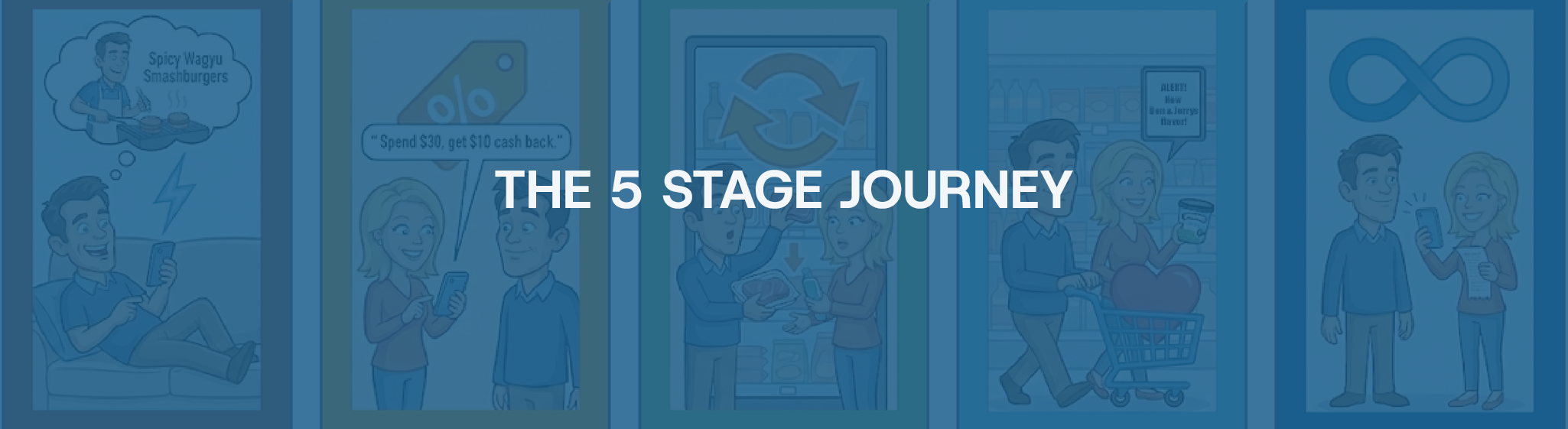
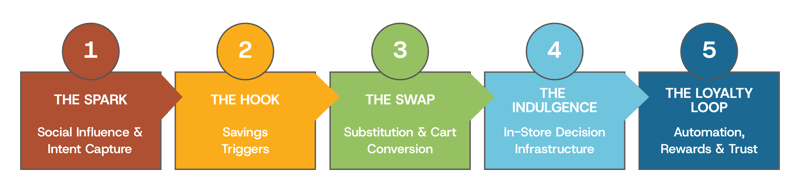
This report examines how this ‘zero-distance’ environment is reshaping shopper marketing across the United States and Europe. Drawing on published research and proprietary analysis, we map five critical moments where brands can still win the decision: the Spark (capture intent), the Hook (make value obvious), the Swap (stay in the substitution set), the Indulgence (re-ignite emotion), and the Loyalty Loop (earn the repeat).

Phil and Claire’s Competing Impulses
It’s a hot summer day, and Phil–lounging on the couch–sees a viral TikTok for Spicy Wagyu Smashburgers. He’s firing up the grill already in his mind. “Claire! BBQ tonight. I have a vision. Trust me.” Before his wife can react, Phil’s already added the recipe list to Instacart through its TikTok integration, plus a conveniently suggested refill of his favorite ice cream.
This is shopper marketing today: everywhere, all at once
Historically, shopper marketing was about winning the shelf with prime placement in grocery aisles. But when more decisions are made before a shopper ever sets foot in a store—if they go at all—that model is eroding. Today, it means influencing the decision wherever it happens: via a billboard, the retailer app, in-store, or inside an algorithm.
With almost zero distance from impulse to purchase, Phil’s vision comes alive fast.
But here’s the rub: Claire.
Claire is not a “vision” person, she’s a numbers person. Wagyu? After Christmas shopping already made a dent in their savings? Cute. She’ll keep the BBQ dream alive, but she’s going to do it her way, taking advantage of every deal in sight.
Successful shopper marketing bridges the gap between Phil's desires and Claire's constraints.
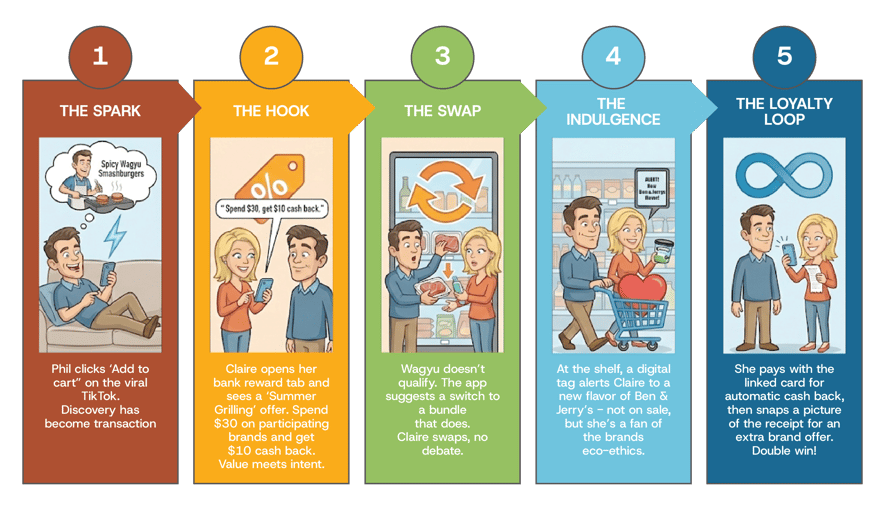
Here's how this plays out in practice:
-
The Spark: Phil clicks "Add to Cart" on the viral TikTok. Discovery has become transaction.
-
The Hook: Claire opens her bank rewards tab and sees a "Summer Grilling" coupon: Spend $30 on participating brands, get $10 cash back. Value meets intent.
-
The Swap: Wagyu doesn't qualify. The app suggests a switch to a bundle that does. Claire swaps. No debate. Brand preference gets stress-tested at speed.
-
The Indulgence: At the shelf, a digital tag alerts her to a new flavor of Ben & Jerry's—not on sale, but she's a fan of the brand's eco-ethics. Emotion re-enters the journey.
-
The Loyalty Loop: She pays with the linked card for automatic cash back, then snaps the receipt for an extra brand offer. Double win.
That's the core shift:
Phil and Claire at scale
Phil and Claire aren't outliers. They're archetypes playing out across millions of households—often within the same person. The tension between emotional drivers (I love that brand’s vibe!) and economic constraints (how much is vibe worth?) is reshaping shopper behavior globally.
Claire is taking precedence—especially when money is tight. For decades, marketers bet on a familiar formula: build emotional connection and “brand love” will keep customers loyal. 65% of marketers still believe that, according to Razorfish. But far fewer consumers agree. Most are guided by price, convenience, loyalty benefits, and whatever fits best in the moment.
 US: higher prices have made loyalty more fluid. Deloitte finds 4 in 10 Americans are deal-driven, and even higher-income households are reassessing what value means to them. The average consumer visits more than 3 different grocery stores per month, up 8% YoY, and 3 in 5 grocery shoppers frequently compare prices between stores.
 Europe: inflation pressure is keeping saving top-of-mind heading into 2026. 41% of UK shoppers switched their main grocer in 2025, and the average shopper rotates between 3.2 grocers, with 80% using two or more regularly. The traditional "weekly shop" has fragmented into top-up missions: fast, functional, and heavily influenced by what's cheapest and actually in stock.
Across both markets: the generational split is telling: Gen Z and Millennials are more exploratory and banner-fluid, while Boomers and Gen X skew more traditionally loyal.
But Phil hasn't disappeared—splurge intent is still there (selectively). Even in a value-driven environment, Phil’s impulse still shows up in specific moments: a scroll that catches him off guard, an in-store display that reignites desire, a limited-edition flavor that creates urgency.
US: 40% of US consumers say they perceive value from non-price factors like quality, service, and ease. McKinsey found intent to splurge remains strong, with dining out and groceries seeing the highest growth in ‘treat yourself’ intent.
Europe: Splurge varies by market. Germany leads at 43%, while France and Italy saw the sharpest declines. But the pattern is consistent: discretionary spend clusters around holiday indulgences, travel, and dining—where experience justifies the premium.
Omnichannel is the battlefield—the modern shopper is no longer “online” or “offline”. People mix online and in-store channels, spread spend across more retailers, and open new pathways to capture incremental trips.
US: Over 90% of grocery consumers now shop both in-store and online, through retailer apps and sites, social platforms, or third-party marketplaces—and 86% of US CPG dollar sales come from omnichannel customers.
Europe: online shopping is mainstream. 75% of people aged 16–74 are “e-shoppers” in 2025, with digital deeply embedded in everyday shopping behavior.
The implication is simple: Brands can’t win by optimizing for Phil or Claire alone. They need to satisfy both. Quickly, with minimal friction, at the moment of decision.
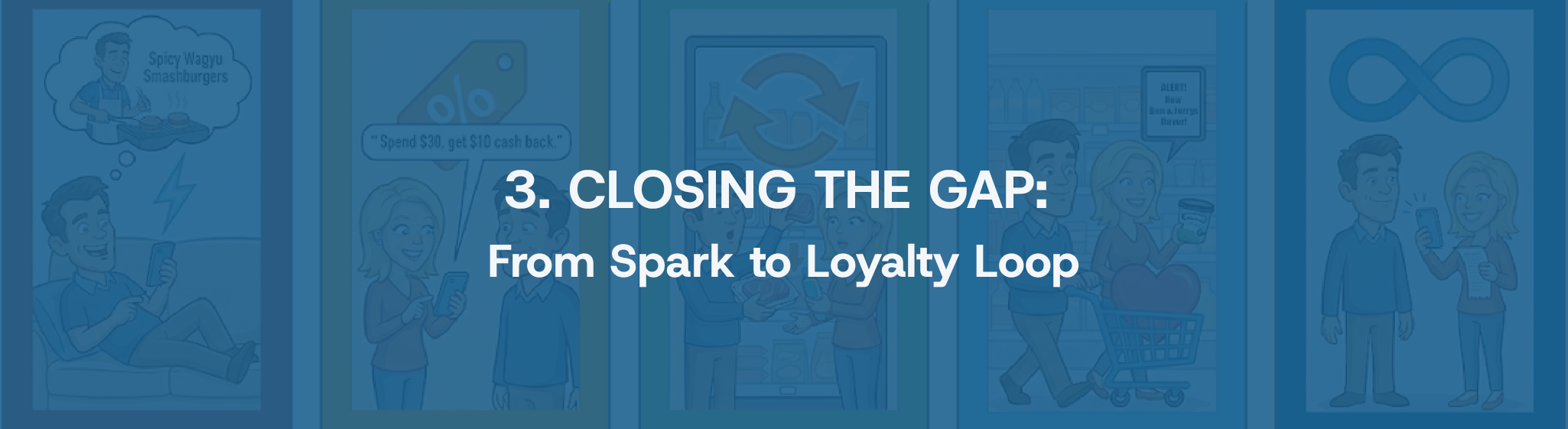
So how do you actually win both of them?
To do that, you have to understand the two operating modes of the modern buyer. For years, brands have obsessed over the “consumer.” But the person enjoying the product and the person buying it are often warring factions—even if they exist inside the same brain.
Call it the Phil vs. Claire Paradox.
Phil is the Consumer. He's driven by emotion, desire, and identity. He says things like: "I want to be the fun dad." "I deserve a treat." "That flavor sounds adventurous." He's influenced by TikTok, TV ads, influencers, and “vibes”. Marketing usually speaks to Phil.
Claire is the Shopper. She's driven by logistics, budget, and efficiency. She says things like: "Is it on sale?" "Do we have room in the fridge?" "Can I get in and out in 10 minutes?" She's influenced by apps, inventory visibility, digital coupons, and anything that removes steps. Shopper marketing must speak to Claire.
Consumer marketing creates the want. Shopper marketing closes it—within constraints.
The disconnect happens when brands sell the dream to Phil but fail to give Claire the tools to execute it. The job isn't to create more noise. It's to remove friction so she can act on what he already wants.
That's what modern shopper marketing does: closing the distance between Phil's impulse and Claire's reasoning, on-site, off-site, and in-store. Quickly enough to capture the sale. Consistently enough to earn the repeat.
THE SPARK: Social Influence & Intent Capture
The Goal: Capture Phil’s "I want it" moment before he scrolls past.
The Spark used to start at the store entrance with endcaps and circulars. Now it starts in the feed, on a billboard, or even via a TV show. For Phil, the gap between "I saw it" "I want it" "I bought it" has never been smaller.
Social commerce has turned discovery into checkout. For grocery specifically, 42% of US shoppers discover grocery ideas or deals on social platforms, and over half say they have bought via social or livestream platforms. Total US social commerce is expected to blow past $100B in 2026, with TikTok Shop alone forecasted to exceed $20B. In the UK, 69% of consumers say they have purchased after seeing a product on social media, with Facebook and TikTok leading.
Commerce-enabled storytelling makes entertainment a shopping trigger. When Carol, the lead character in Apple TV's Pluribus, said “I just want my Sprouts back” in a pivotal episode, the grocery chain leaned in. It ran a sweepstakes for a year of Apple TV+ and launched "Carol's Collection" on their e-commerce site. Walmart took a different route with its 2025 holiday campaign: a Dr. Seuss-inspired world called "WhoKnewVille" that dramatized a familiar problem—I don't know what to buy—with products surfacing through an interface that mimicked the app itself. When the Grinch hijacked Times Square and NFL broadcasts for Black Friday, the cart was always one tap away.
Shoppable video and off-site retail media bring “add to cart” to the open web. In the US, shoppable video is one of the fastest-growing segments, up 42.1% in 2025, with 72% of retail media advertisers saying video is a primary off-site focus. In Europe, off-site retail media is gaining traction as well: 46% of buyers now allocate meaningful budget to it, up from 30%, driven by display and social formats.

Agentic commerce compresses the journey further. If Phil can say 'get me snacks for movie night' and complete the purchase without opening five apps, that's a new conversion surface. Walmart has announced integrations with conversational AI (including OpenAI’s ChatGPT in October 2025 and Google’s Gemini chat in January 2026) that support product search, cart-building, and checkout through chat.
THE HOOK: Savings Triggers
The Goal: Give Claire a reason to say "Yes" – so she doesn't have to hunt.
The Hook is the moment a “nice idea” turns into “worth it.” It’s why loyalty offers, digital coupons, cash-back mechanics, and targeted promotions matter more than ever. In a fluid loyalty environment, value doesn’t have to mean “cheap”, but it does have to mean justifiable: easy to validate, easy to redeem, and clearly better than waiting for a better deal later.
Digital promotions have become Claire's decision lever—for both brand and store choice. Over 40% of US grocery shoppers now use smartphone-based coupons (roughly double the rate of paper coupons), and 76% say promotions meaningfully improve a brand’s value to them. Critically, promotions have become decision tools: 67% say the availability of digital coupons influences where they shop, and half say better promotions would bring them back to brands they've left.
Financial and payments ecosystems are becoming Hook surfaces. If Claire is already in a banking or rewards app, an offer can meet her where she manages money—not just where she browses products. That turns saving into a trigger and expands shopper marketing into a channel most brands never used to think of as commerce. Mastercard launched its Mastercard Commerce Media in October 2025, and Snipp's partnership with Inmar links Inmar's digital incentives retailer network with Snipp's Financial Media Network, so CPG offers can be delivered directly inside consumer banking apps.
THE SWAP: Substitution & Cart Conversion
The Goal: Keep Phil's impulse alive while meeting Claire's rules.
The Swap is where brand preference gets stress-tested—at speed. A product doesn’t qualify for an offer, an item is out of stock, or a competing deal appears, and the shopper substitutes. In a “zero-distance” environment, the consideration window is just a few seconds. If Wagyu doesn’t qualify, Claire doesn’t mourn. She swaps.
That’s why retailer apps, on-site search, and retail media matter. They don’t just build awareness; they determine what Claire sees as the best available option under her constraints: price, eligibility, availability, and convenience. If your product doesn’t surface when she searches “gluten-free pasta” or “snacks under $5,” you don’t exist in the decision.
Retail media networks (RMNs) can influence substitution at the exact moment of selection. The category is exploding: US advertisers spent $60.3B on retail media in 2025 and a re projected to spend about $71B in 2026 according to eMarketer’s forecasting. Europe is on a similar trajectory. Retail media grew 21.1% in 2024 (nearly four times the overall ad market's pace) reaching €16.9B in 2025, and expected to hit €29B by 2028.

Connected commerce reduces the steps between "that works" and "it's in my cart. "US grocer Albertsons launched an off-site click-to-cart capability (“Add-It”) that lets shoppers add products, recipes, and offers directly into an Albertsons cart. General Mills piloted it to promote limited-edition Peanuts-themed Chex with a “buy three, get a free tin” offer and a recipe tie-in. A multi-unit promo became a single tap—pure Claire logic.
Delivery and marketplace intermediaries are swap surfaces too—shaping what shoppers see, substitute, and reorder. DoorDash and Instacart have built ad businesses above $1B annualized scale, making them major substitution platforms. Instacart’s partnership with Pinterest enables shoppable grocery ads, capturing discovery while keeping conversion measurable. The value of these platforms isn't just media; it’s cross-retailer consumer insight that shows how preferences shift by category, occasion, and price sensitivity.
THE INDULGENCE: In-Store Decision Infrastructure
The Goal: Re-ignite Phil’s emotion in the physical aisle. Without slowing Claire down.
In-store is still where a majority of spending happens. According to a survey from eMarketer and Amazon Ads, nearly 60% of US consumers shop in-store at least weekly, compared with just under a third who shop online that often. Visa’s 2025 holiday analysis found 73% of payment volume was in physical stores vs 27% online. In-store is also where shoppers are most persuadable: Vestcom research found in-store messages are three times more likely than digital ads to influence a shopper trying something new, and 3 out of 4 shoppers report making unplanned purchases from in-store marketing. This is where emotion re-enters the journey—fast, and at the point of choice.

Electronic shelf labels (ESLs) are infrastructure for instant persuasion. Flash deals, competitive matching, eligibility cues (“club price”), and attribute callouts (“gluten-free”) can be updated in real time across thousands of SKUs. Europe leads globally with almost 600M ESLs installed, the highest adoption rate in the world. The US is catching up: Walmart’s partnership with SES-Imagotag will deploy 60M tags across 500 stores in Phase 1.
Smart carts act like the retail app on wheels. They can reduce checkout friction, show running totals, and—when linked to loyalty—surface offers as shoppers move through the store. Industry data suggests basket sizes increase up to 30% with them. Amazon is expanding its latest-generation Dash Carts to dozens of Whole Foods locations by the end of 2026. The new versions feature built-in screens for updated prices, totals, maps, and nearby personalized offers.

THE LOYALTY LOOP: Automation, Rewards & Trust
The Goal: Make the next purchase a default.
The app is the modern shopper’s front door. 45% of US adults use a loyalty or digital mobile app with their primary grocery store, and 41% of online grocery shoppers say app quality determines where they shop. What they say they want is simple: the basics to work (inventory truth, accurate pricing), rewards that feel meaningful (not just points), and personalization that helps (not surveillance). For Claire, the app is the control panel: it’s where she checks prices, verifies stock, clips offers, and decides whether a retailer is reliable.

All of that forms part of the Loyalty Loop.
Inventory truth is non-negotiable. Real-time inventory visibility is a top demand, and retailers still fall short. 87% of UK shoppers have experienced “ghost inventory”, where the system says it’s there, but the shelf says otherwise. Beyond annoying, it’s a trust break that pushes shoppers to competitors. In the US, when asked what would improve the online-to-store experience, “real-time store inventory (plus aisle locations)” sits at the top of the list.

Rewards have to feel like real-life benefits. Shoppers increasingly want “soft benefits”: exclusivity, early access, and perks that signal the retailer understands real life, not just generic points tallies. In the US, over half of shoppers say exclusive app-based discounts would make them more likely to use digital tools in-store, and 38.4% say gamified loyalty—challenges, streaks, unlocks—would influence them to visit stores more often. Tesco's Clubcard Challenges invited members to complete personalized challenges over six weeks to unlock up to £50 in points, with challenge thresholds tailored to each participant. Its popularity led to later campaigns scaled to 10 million customers.

AI-powered personalization only earns trust when it delivers obvious value—saving time, effort, or money. In the UK, 64% of consumers want retailers to prioritize these outcomes, and 61% are already using AI in shopping contexts. The US market reflects the same shift: over half of consumers (51%) say tailored promotions are important, and comfort levels with AI tools are rising. Notably, Deloitte’s 2025 Holiday Retail Survey found that one-third of US shoppers are ready to let AI automatically reorder staples when supplies run low. Walmart is leaning into this readiness with its 'Stores of the Future', using AI to refine recommendations, enable 'endless aisle' browsing, and streamline the path from cart to doorstep. But privacy and bias concerns persist. AI earns trust only when it stays invisible and delivers clear value.
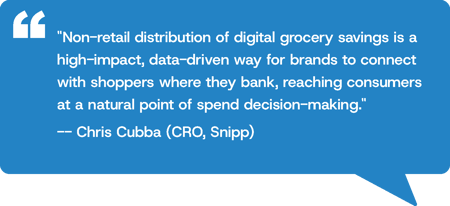
Zero Distance Realized
It's 11:47 pm.
Phil's scrolling. A chef he's never seen before is making birria ramen: beef consommé poured over noodles, cheese crisped at the edge of the bowl, lime squeezed at the last second. Phil doesn't save the video. He just watches it twice.
-
The Spark: Phil's AI agent catches the pause (permissioned). Parses the recipe and logs his intent.
-
The Hook: The agent cross-references Claire's household rules. A stored coupon comes into effect tomorrow at 10 am. It waits.
-
The Swap: The high-sodium seasoning packet gets swapped for a clean-label alternative Phil's bought before. The beef gets routed to a linked retailer with a better price, within Claire’s 15% threshold.
-
The Indulgence: Last week, Phil lingered at the premium gelato display, not the ice cream they usually buy. He didn’t add it, too expensive. But the store app logged the dwell time. Now it’s 30% off—within Claire’s threshold—and the agent adds it to the order. Phil forgot he wanted it. The system didn’t.
-
The Loyalty Loop: Payment, rewards, and cash back trigger in the background. The receipt lands in a ledger Phil never opens.
At 6:15 the next evening, a bag hits his doorstep. When he opens the birria seasoning, it smells exactly like the video looked. And there's a tub of gelato he didn't know he'd ordered, but had wanted to try.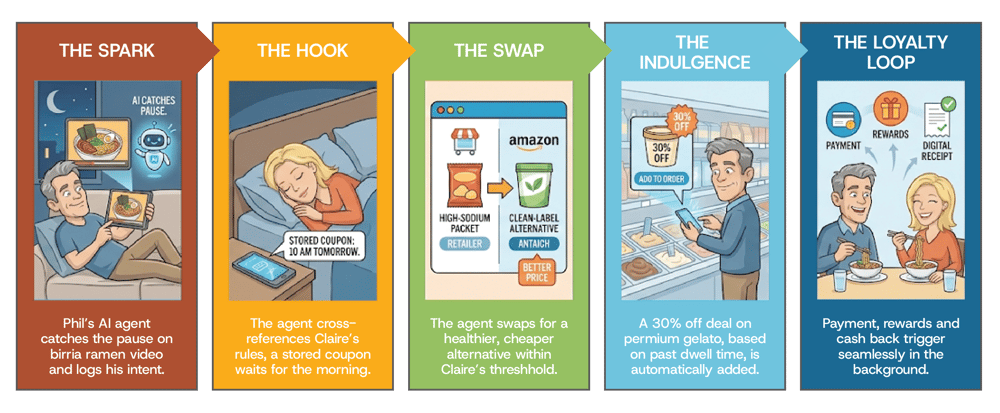
Discovery was purchase. Browsing was intent. Claire made sure both were smart.
The new job of shopper marketing
In a world where future Claire sets the household rules and shopping agents increasingly manage the “how,” the question is no longer Did this ad convert? It’s: Did we make the consideration set before the system narrowed the options? If an AI agent were shopping for Claire, would it recommend you—and would it know why?
That’s the new job of shopper marketing. Here’s how to stay in the mix:
FOR CPG BRANDS
Build direct signals. Strengthen first-party relationships through DTC, loyalty partnerships, and app-linked engagement. Brands with reliable consumer signals are more likely to be the ones Claire’s agent recognizes when it starts filtering options.
Align the messaging. Brand marketing and trade marketing have to say the same thing. The promise in a TV spot should match the shelf tag, influencer content, and in-app offer.
Position around value drivers, not features. Anchor messaging in the value drivers and outcomes shoppers filter for—health, convenience, sustainability— so you consistently qualify for the household’s rules.
Follow discovery where it migrates. Gen Z is already drifting toward Reels, YouTube Shorts, Discord, Reddit—even AI chatbots like ChatGPT. This is less about platform loyalty and more about showing up in the formats where discovery actually happens: short video, community threads, search-like chat, and shoppable content.
FOR RETAILERS
Invest in digital infrastructure. Modernize the store as a digital interface, one that reduces friction and captures intent: ESLs, digital signage, smart carts, Wi-Fi, and reliable pickup/delivery operations. Treat AI and automation as relevance and service tools, not just ad tech. 25% of US consumers say online store services (delivery, BOPIS) will be among the most important factors in where they shop over the next five years.
Move loyalty from points to prediction. Personalization must feel useful: timely offers, replenishment prompts, and context-aware recommendations. A quarter of industry executives have already invested in AI-powered personalization; another third expect to within the year. The bar is rising. Points-for-purchases won't clear it.
Eliminate omnichannel seams. Today’s consumers expect brands to be online and in stores. In the future, those expectations will only grow, with shoppers wanting to switch between digital and physical experiences without missing a beat. A strong omnichannel experience is essential. Smooth transitions across online, mobile, and in-store aren't a differentiator anymore—they're table stakes.
Standardize measurement and interoperability. Retail media fragmentation creates operational drag: 86% of grocers in the US say their RMNs aren’t integrated with other marketing. CPMs are rising, and in-store access remains difficult: approximately 1 in 4 ad buyers cite it as a top challenge. Build common standards and integration so RMN performance connects to broader marketing measurement and store outcomes.
FOR ALL STAKEHOLDERS
Prioritize trust. As AI agents and in-store cameras proliferate, privacy becomes paramount. Shoppers will trade data for value, but they’ll revolt against surveillance without benefit. Lead with clear opt-ins, simple controls, and an obvious value exchange—no creepy ambiguity.
Prepare for agentic commerce. Shopping agents are shifting discovery and purchase away from traditional search and traditional marketing. With one-quarter of US shoppers forecasted to use specialty retail chatbots in 2026, the brands that win will be the ones agents recommend. That means clean product data, consistent availability, and Claire-approved credentials embedded in product information.
Think bridges, not funnels. The future is connected commerce: content and commerce converging so discovery and fulfillment collapse into a single moment. You're watching Ratatouille and you can order the cheese on screen. Design the connective tissue: shoppable content, interoperable carts, and fulfillment options that make “want” immediately actionable.

Zero distance, infinite repeat
The tools of shopper marketing have transformed. Social commerce. Retail media networks. AI agents. Smart carts. Shoppable content. Financial media networks. But the objective remains unchanged: influencing the decision at the moment that matters.
In 2026 and beyond, that moment is everywhere. It's an 11:47 pm scroll. It's a Sunday morning configuration screen. It's a dwell time logged at a shelf Phil doesn't remember visiting. The moment that matters might have already happened before the trip even begins.
The brands that pull ahead won't optimize channels in isolation. They'll build connected systems: capturing Phil's attention in the feed, converting Claire's intent at the shelf, and earning trust through personalization that actually helps. Zero distance isn't a destination. It's the new pace of competition.
Click here to download this report