Consumers have always looked for ways to make better purchase decisions. They compare prices, read reviews, search for promotions, ask for recommendations, and look for loyalty programs that give them more value.
What is changing is where that discovery happens.
Increasingly, consumers are turning to AI to research products, compare options, find the best value, and decide what to buy. According to NielsenIQ, 42% of consumers have used at least one AI tool to shop within the past month, with AI already influencing product recommendations, price comparisons, and purchase decisions. More recently, NIQ reported that 74% of shoppers use AI for product discovery.
That shift creates a new opportunity for brands: make shopper marketing discoverable inside the AI experiences consumers are already using.
From search results to conversations
Traditional digital marketing has largely been built around search.
A consumer searches for a product, a promotion, a retailer, or a loyalty program. Brands compete to appear in the results, drive the shopper to a destination, and then convert the interaction.
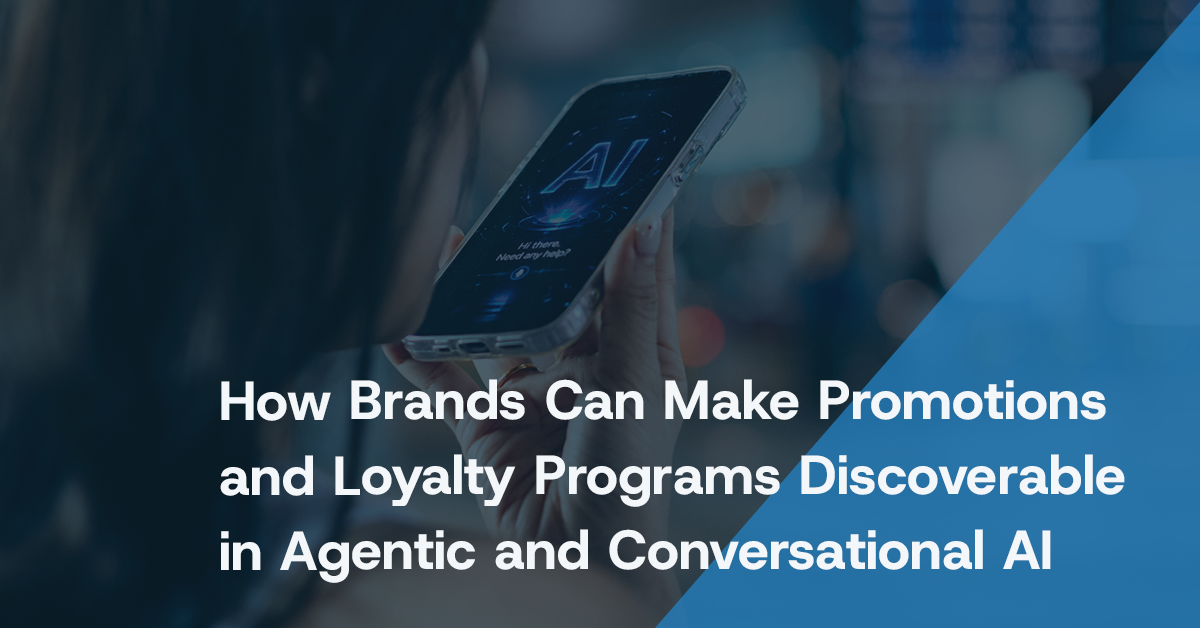
Conversational AI changes the interaction.
A shopper might ask:
- “Are there any promotions on laundry detergent?”
- “What rebates are available for pet food?”
- “How can I save money on my weekly grocery shop?”
- “Are there loyalty programs that reward purchases of this brand?”
- “What offers can I use for the products I’m planning to buy?”
The opportunity is no longer simply to rank for the question. It is to provide a relevant, actionable experience in response to it.
For shopper marketers, this creates a potentially important new channel for promotions, offers, rebates, rewards, and loyalty.
The market is moving from AI-assisted shopping toward agentic commerce
Today’s AI shopping experience is still relatively early, but the direction is clear.
Morgan Stanley estimates that AI-powered shopping assistants or “agentic shoppers” could influence $190 billion to $385 billion in U.S. e-commerce spending by 2030, representing approximately 10% to 20% of online retail. Its research also found that roughly 23% of Americans had purchased something using AI in the previous month.
The opportunity is particularly relevant to everyday categories. Morgan Stanley found that groceries and consumer packaged goods are already among the categories where AI-driven purchases are most common.
For brands, this means AI is potentially becoming more than another discovery channel. It could become part of the transaction journey itself.
The question for shopper marketers is therefore shifting from:
“How do we appear in AI?” to “What can we actually do once a shopper finds us there?”
The challenge: AI discovery still needs real infrastructure
Making a promotion discoverable through AI sounds straightforward.
Making the resulting experience accurate, measurable, and connected to a verified purchase is considerably harder.
Enterprise shopper marketing programs rely on infrastructure that consumers rarely see. A promotion may need to determine whether a purchase is eligible, validate a receipt, identify the products purchased, detect fraud, apply the correct offer rules, fulfill a reward, and ultimately connect the transaction to campaign performance.
These capabilities become particularly important when AI moves from simply answering a question to helping a shopper take action.
That is where Snipp’s existing infrastructure becomes important. For more than two decades, Snipp has built technology around the connection between marketing activity and verified purchases. Its receipt processing infrastructure supports receipt validation, receipt intelligence, SKU-level purchase data, fraud prevention, offer rules, reward fulfillment, identity resolution, and campaign analytics.
Originally built to power promotions and loyalty programs, this infrastructure can now support discovery and engagement through AI.
In other words, the AI interface may be new, but the underlying shopper marketing plumbing is not.
Bringing promotions and loyalty into AI
AI Is the new front door to commerce: How Snipp brings promotions and loyalty into ChatGPT and Claude
Snipp is extending this infrastructure, working with Alpic on the app build and hosting, into conversational AI with its $nipp ChatGPT Plugin and $nipp Connector for Claude
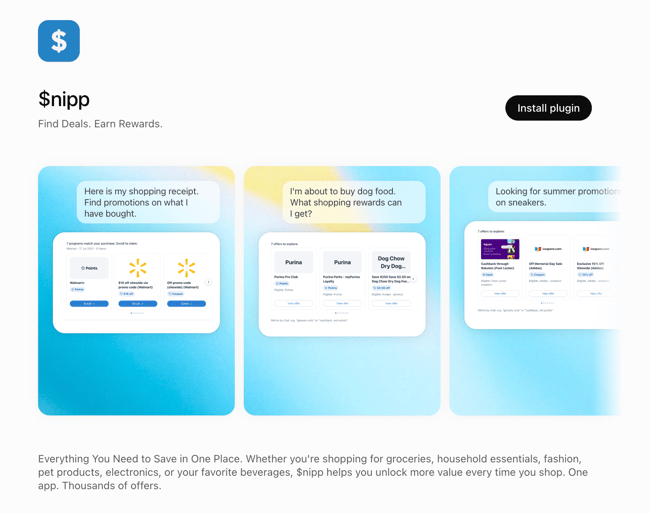
The idea is simple: give brands a way to make their existing promotions, rebates, rewards, and loyalty programs discoverable through AI-powered conversations.
Rather than requiring brands to build and maintain separate integrations for every emerging AI channel, Snipp provides a connection between these experiences and the infrastructure already supporting their shopper marketing programs.
For consumers, this means they can discover relevant opportunities using natural language.
For brands, it creates a new potential engagement point earlier in the purchase journey — when a shopper is actively researching what to buy, where to buy it, or how to get more value from a purchase.
The opportunity goes beyond loyalty
This evolution is bigger than loyalty.
Loyalty remains an important part of the experience, but consumers don’t necessarily think in categories such as “loyalty,” “promotions,” or “rebates.”
They think in terms of needs:
What should I buy?
Where should I buy it?
Can I save money?
Is there an offer?
Can I get rewarded for this purchase?
AI is increasingly capable of understanding those questions in context.
That creates an opportunity to bring multiple shopper marketing mechanics together in a single conversation, from promotions and rebates to rewards and loyalty rather than making consumers navigate each experience independently.
The opportunity is especially relevant because traditional loyalty itself is facing an engagement challenge.
New 2026 research found that 86% of consumers say loyalty rewards matter to them, yet regular program usage remains substantially lower. Upside describes this as a “loyalty plateau,” with consumers increasingly juggling multiple programs and becoming harder for any single program to influence.
AI could provide a new way to close part of that gap: instead of expecting consumers to remember which programs they belong to, open an app, search through offers, and navigate separate enrollment experiences, relevant value can potentially be surfaced when the shopper is already asking what to buy.
Why purchase verification matters
There is another important distinction between AI-powered discovery and traditional search. An AI assistant can recommend an offer. It cannot, by itself, guarantee that the shopper actually purchased the qualifying product. For brands, that distinction matters.
The value of shopper marketing ultimately comes from connecting an interaction to an outcome. Verified purchase data provides the bridge.
Snipp’s receipt and transaction infrastructure is designed to establish that connection by validating purchases, identifying products at the SKU level, applying rules, managing fraud controls, and enabling rewards or other outcomes.
That creates a foundation for a more complete AI-powered shopper journey:
Discover → Decide → Purchase → Verify → Reward → Learn
The AI experience handles the conversation and discovery. The underlying shopper marketing infrastructure handles the transaction and verification.
From AI discovery to agentic shopper marketing
The longer-term opportunity goes beyond simply making offers searchable through AI. As AI agents become more capable, they can potentially move from answering questions to taking actions on behalf of consumers.
That could mean helping a shopper discover an offer, determine eligibility, navigate enrollment, submit a receipt, validate a purchase, and access a reward, all within an increasingly seamless conversational experience.
For brands, the opportunity is equally significant.
AI could eventually help marketers use verified purchase data and real-time offer logic to recommend, configure, test, and optimize promotions with far less manual intervention.
This is where the concept of agentic shopper marketing begins to emerge.
The objective isn’t to remove marketers from the process. It is to remove unnecessary operational complexity so marketers can focus on strategy while intelligent systems handle more of the execution.
The next shopper marketing channel
The shift toward AI-powered shopping doesn’t mean search, retailer websites, apps, or loyalty platforms disappear. It adds another layer.
AI is becoming an increasingly important interface between consumers and commerce. NIQ’s latest research suggests that AI is already influencing product discovery at significant scale, while Morgan Stanley’s projections point toward a much larger role for AI-powered shopping assistants in the years ahead.
Brands that want to participate in that environment will need more than visibility. They will need the infrastructure to deliver accurate, relevant, measurable experiences once the shopper engages.
That is why the future of AI-powered shopper marketing is not just about the AI.
It is about connecting consumer intent to real marketing mechanics and verified purchase outcomes.
Snipp’s move into ChatGPT and Claude is a step in that direction: extending the promotions and loyalty infrastructure brands already use into a new consumer engagement channel and laying the foundation for a more intelligent, connected, and ultimately agentic approach to shopper marketing.
What’s Next
The ChatGPT and Claude launch is the first step, not the full roadmap. Alongside the $nipp plugin and connector, Snipp is also launching the industry’s first Model Context Protocol (MCP) server for shopper and loyalty marketing, an open standard that lets AI applications and agents connect securely to Snipp’s enterprise infrastructure. That MCP server is the foundation for what comes next.
From here, Snipp plans to expand its AI capabilities further, adding integrations with additional AI platforms and expanding the ChatGPT plugin’s capabilities. The longer-term goal is an agentic layer that does more than surface offers. It will help brands build, optimize, and test promotion strategies using store- and SKU-level intelligence, while advancing fraud detection and purchase validation into increasingly autonomous systems that catch errors before a campaign launches.
None of this removes marketers from the loop. It removes the operational weight so marketing teams can spend more time on strategy and less on execution.
Ready to bring your promotions and offers into AI?
Brands don’t need to build this infrastructure themselves. Talk to the Snipp team about the $nipp ChatGPT Plugin and Claude Connector, and see what it takes to make your promotions, rebates, and loyalty programs discoverable in the AI experiences your shoppers are already using. Contact us to get started.
Subscribe for updates straight to your inbox