<img height="1" width="1" style="display:none;" alt="" src="https://px.ads.linkedin.com/collect/?pid=2989969&amp;fmt=gif">

Latest Consumer Survey: How Rising Gas Prices are Reshaping American Grocery Carts

Digital Rebates main banner

Rebate Marketing in 2026

Rebate Trends, Challenges and What's Working Now

Share
 

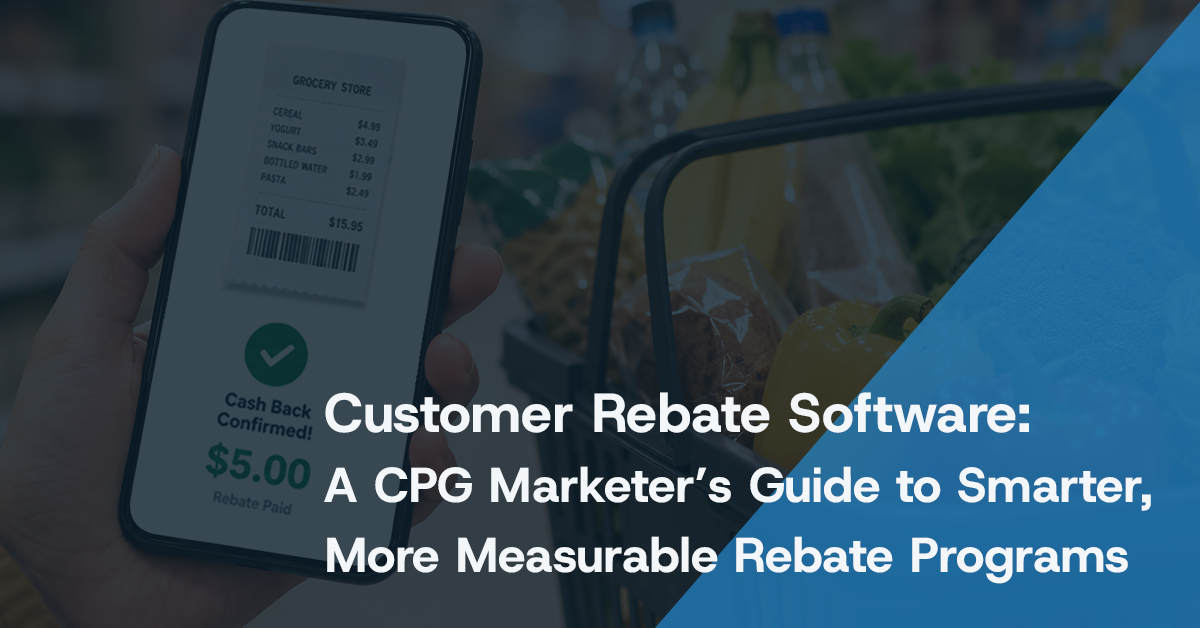
Rebate marketing is a promotional strategy where a brand gives money or value back to a customer after a verified purchase, instead of cutting the price upfront at checkout. The shopper pays the advertised price, submits proof of purchase, and receives a reward once the brand confirms the sale. A rebate in marketing does three jobs at once:

  1. It drives trial without permanently devaluing shelf price,

  2. It captures consented first-party data that CPG brands rarely get when selling through retail, and

  3. It ties promotion spend to verified sales. Done well, a rebate is the start of a customer relationship, not the end of a transaction.

TL;DR: What's shaping rebate marketing right now

Four trends transforming the category:

  • Retail media is making first-party purchase data a must-have. Brands – particularly CPGs – need verified shopper data they can use to plan, target, measure, and personalize.
  • Cashback and loyalty mechanics have reset the bar. Shoppers have come to expect value back after purchase.
  • Faster payouts are becoming an expectation. Rebates compete with digital wallets and instant refunds – not with old-school mail-in checks.
  • AI-generated receipts are the new fraud surface. Proof of purchase matters, but human review and basic OCR are no longer enough.

Three challenges every rebate marketing strategy now has to solve:

  • Designing for shoppers who treat value back as a baseline, not a bonus.
  • Validating receipts at scale when AI fakes are easy to create.
  • Turning every claim into permission-based first-party data – without breaking consent or disclosure rules.


What is a rebate in marketing and why does it still work?


The simplest rebate definition marketing teams can use: a rebate gives money back after a customer makes and proves a qualifying purchase.

A discount drops the price at checkout. A rebate keeps the advertised price intact, then rewards the customer once the purchase is proven. Here’s where this small mechanical difference makes a big strategic one:

  • Rebates protect price architecture. Unlike discounts, which reduce the price for every purchaser, rebates only incur a cost when consumers redeem the offer. Research found that a 10% discount increased sales by 20%, while a 10% rebate increased sales by 18%. Although the study does not determine how many purchasers were directly influenced by the rebate, only 38% ultimately claimed it. For brands, that translated into a similar sales impact with significantly lower promotional payout costs, helping preserve both margins and long-term price perception.
  • Rebates meet today’s value-seeking consumer: Rebate math matters in 2026 because value-seeking is no longer a short-term recession behavior. Deloitte's 2026 Global Consumer Products Outlook found that 47% of global consumers – including 35% of high-income households – make regular tradeoffs around convenience, cost, and deal-seeking. In the US, McKinsey found that 75% of US consumers traded down in at least one category in 2025. The value-seeking pattern holds in Europe as well: branded products are now discounted more than twice as heavily as private labels just to compete. A rebate pricing strategy earns its place in this race-to-the-bottom environment, protecting shelf price while rewarding specific behaviors.
  • Rebates make promotional spend more measurable. CPGs are under pressure to invest more in promotions, yet many still struggle to connect marketing spend to actual purchase behavior. The POI 2026 State of the Industry Report found that when brands gained better visibility into promotion performance, 34% eliminated underperforming promotions altogether. Rebates are one of the few trade-spend tools that naturally create a closed-loop attribution model. By tying an offer to a verified purchase event, brands can see who bought, what they bought, when they bought it, and which promotion influenced the transaction. This creates a direct line between promotional investment and consumer action, helping marketers optimize spend with greater confidence. Of course, that attribution is only as reliable as the validation layer behind it, making robust receipt verification and fraud prevention essential.


That's the case for a rebate pricing strategy: protecting shelf price, rewarding specific behaviors, and tying every payout to a verified purchase. And when the program is digital, every claim is also a permission-based data moment — product and SKU purchased, retailer, basket, time, location and campaign.

And there's something else trade dollars rarely buy: trust. NIQ finds 62% of US consumers rate trusting a brand as "very important", and 97% as at least somewhat important. A rebate that pays out fast and without friction is one of the few brand interactions that earns it.


Key Digital Rebate Trends

Four Trends Transforming the Category

1

Rebate Marketing Trend 1: Retail Media Is Making First-Party Purchase Data a Must-Have

Most CPG brands don't own the customer relationship. The retailer does. Retail media has turned that imbalance into a full business model. Networks like Walmart Connect, Amazon Ads, Kroger Precision Marketing and others run on verified purchase data – what shoppers bought, when, and where – and Forrester forecasts global retail media spending will grow 70%, from $184 billion in 2025 to $312 billion by 2030.

Meanwhile, the third party tracking that brands relied on for targeting and measurement is declining fast. What remains is first-party data, and most CPGs don't have enough of it. A digital rebate program is one of the most powerful and easily deployable mechanics that generates it at scale. Every redemption is a verified purchase by a known shopper, with consent attached. That feeds audience building, retail media planning and closed-loop measurement.

A rebate marketing example

  •  Scotts Miracle-Gro wanted a digital alternative to its legacy mail-in rebate program – one that let shoppers submit receipts by text, email, or web upload across multiple offers. Every validated claim produced a structured, consented data point, giving the brand richer insights than the paper-based process could deliver.

The takeaway:

A rebate that only clears stock is a tactic. A rebate that verifies purchase, earns consent, and builds a usable customer dataset becomes part of a brand's data strategy.

2

Rebate Marketing Trend 2: Cashback and Loyalty Expectations Have Reset the Bar

For many Gen Z and millennial shoppers, value back after a purchase isn't a perk – it's a baseline expectation. Whether it's a loyalty program, a cashback app, or a rebate, the mechanic may differ but the expectation is the same: buy something, prove it, and get something of value back.

The data backs it up. 95% of Gen Z and millennials say loyalty programs influence whether they buy from a brand again. 79% of consumers now use Pay-with-Points at checkout – double the 2023 rate – and 96% say flexibility is the top factor when choosing a loyalty program. These shoppers want value back in a form they can actually use.

European retail shows where this leads. Tesco Clubcard, Carrefour's MyClub, and Germany's Payback network — over 700 partner brands spanning retail, fuel, and travel, used by 35 million consumers — have trained shoppers to expect personalized value, app-based identification, and rewards that go beyond a single transaction.

A rebate marketing example:

Colgate feature logoColgate’s B2B rebate program lets dentists earn $150 digital gift cards by uploading codes from qualifying teeth-whitening kits and answering a short survey. While not a mass consumer rebate, it shows the strategic value of the mechanic. The brand rewarded verified participation, captured professional audience data, gathered product feedback, and created a known audience for future engagement. 

The Takeaway:

Rebates aren't competing with other rebates any more. They're competing with every loyalty app the shopper already has on their phone. 
3

Rebate Marketing Trend 3: Faster Payouts Are Becoming an Expectation

The old rebate experience taught shoppers to wait. Mail a form. Cut out a barcode. Include the receipt. Wait six to ten weeks. Hope the check arrives.

That timeline now sits alongside PayPal, Venmo, and instant payouts. A shopper who gets a food-delivery refund in 60 seconds has little patience for a rebate that goes silent for weeks. The data reflects that shift: 45% of rebate and refund recipients now expect same-day payouts, the share of US payments delivered instantly has tripled from 16% to 45% since 2020, and 57% of consumers who try instant payouts make it their default — up from 39% in 2020. In Europe, the EU's Instant Payments Regulation (EU) 2024/886 is mandating instant payment infrastructure at a systemic level, raising the baseline further.


But the industry hasn't caught up. Mail-in rebates still take 6–10 weeks. Digital platforms can deliver same-day via push-to-debit, virtual prepaid cards, or digital wallet credit. Not every rebate needs to pay instantly, but brands should be explicit about the timeline. "Approved within 48 hours, paid within 5 business days" is a better customer experience than silence.

The Takeaway:

Payout speed isn’t just an operational detail, it’s part of what the rebate is worth.

4

Rebate Marketing Trend 4: AI-Generated Receipts Are the New Fraud Surface

The biggest change to rebate marketing in the past 18 months isn't about consumers. It's about fraudsters.

Loyalty and rewards programs are already prime targets. Sift's Q1 2025 Digital Trust Index found loyalty points had the highest fraud attack rate among digital payment types at 6.19%, well above credit cards at 1.31%. At the same time, generative AI has made fake receipts incredibly easy to produce at scale. AppZen found that AI-generated receipts made up 14% of fraudulent documents submitted in September 2025, up from zero a year earlier. Fintech Ramp flagged over $1 million in fraudulent invoices within 90 days of switching on new detection software. That's expense fraud, not rebate fraud, but both depend on the same kind of submitted documentation. On the identity side, the LexisNexis 2026 Cybercrime Report found synthetic identity fraud – fabricated identities built from stolen data – now accounts for 11% of all fraud globally, an 8x jump in one year.

Basic validation isn’t enough anymore. Modern rebate programs need sophisticated, layered fraud detection running invisibly in the background: OCR, product matching, duplicate checks, device signals, image metadata analysis. The goal: catch fraud before payout, without adding friction for legitimate claimants.

The Takeaway:

AI-generated receipts don’t eliminate the value of rebates, they raise the standard for validation.


Three Challenges Every Rebate Marketing Strategy Has to Solve
1

Rebate Challenge 1: How do brands design rebate experiences for shoppers who expect value back?

Start with the offer. The reward should be motivating enough to prompt action, simple enough to understand quickly, and tied to a behavior the brand actually wants: trial, repeat purchase, basket growth, trade-up, loyalty sign-up, or purchase through a specific retailer.

The next step is reducing friction. A customer shouldn't have to print forms, cut barcodes, type long codes manually, or wait in the dark. A modern rebate flow should allow phone-based receipt capture, clear eligibility rules, automated status updates, and a payout method the shopper already uses. Automated receipt validation does three jobs at once: it streamlines the consumer experience, captures structured purchase data — including retailer, products purchased, basket composition, and purchase date and time — to power attribution, measurement, and shopper insights, and it enforces promotion rules before rewards are distributed. By combining receipt processing with qualification logic and fraud protection, brands can ensure rewards are issued only for legitimate, qualified purchases while reducing exposure to ineligible, manipulated, and duplicate claims.

Finally, think past the payout. The best rebate doesn't end when the money arrives. It opens the next door: a loyalty program invite, a follow-up offer, a product review request, a warranty registration.

A rebate marketing example:

IAMS's Checkup Challenge shows what this looks like in practice. Pet owners who spend $50 on IAMS products and take their pet for an annual vet visit can upload both receipts to claim up to $150 back via PayPal. The reward is meaningful, the behavior is specific, and the mechanic is simple. IAMS has run the program for four consecutive years — proof that the program is doing more than clearing stock.

The Takeaway:

Every rebate that ends at payout is a missed chance to extend the brand-consumer relationship.

2

Rebate Challenge 2: How do brands validate receipts at scale when AI fakes are easy to create?

That's why validation has to move beyond "does this look like a receipt?" to "does this submission behave like a real purchase?" That means assessing the image, the metadata, the device, the submission pattern – not just what's printed on the page. Fraud control is no longer visual, it is logical and arithmetical. AI-powered fraud detection can verify receipt logic and arithmetic in milliseconds: Platforms like Snipp's Receipt Processing and Snipp's CORRAL anti-fraud AI do this in the background, flagging suspicious patterns before payout while keeping the experience simple for legitimate claimants.


The Takeaway:

Fraud prevention built in from day one is a different problem than fraud prevention bolted on after abuse appears.

3

Rebate Challenge 3: How do brands turn every redemption into first-party data without breaking consent?

Brands turn rebate redemptions into useful first-party data by being upfront about the exchange. What's being collected, why, how it's used, and what choices the shopper has. The hard part isn't capturing the data. It's earning the right to use it.

The regulatory backdrop is clear: GDPR requires consent to be freely given, specific, and easy to withdraw. CCPA gives California consumers the right to know exactly what's collected and with whom it's shared – and to opt out. The detail varies by market, but the principle is the same everywhere: tell people what they're agreeing to before they agree.

Regulators are paying attention. In December 2025, Menards paid $4.25 million to settle with ten state attorneys general over its “11% Rebate Program” advertising that made shoppers believe they were getting a point-of-sale discount – when they were actually earning future store credit. The lesson goes beyond one brand: how a rebate is advertised, and what shoppers think they're handing over their data for, now carry real legal weight.

Most rebate programs still fall short. Shoppers click through a generic opt-in box and move on with no idea what's being collected, how it's stored, or who else sees it. That's a privacy incident waiting to happen. It's also a missed opportunity. Deloitte's 2025 Consumer Loyalty Program Survey found 89% of Gen Z and 87% of millennials will share personal data for tailored offers — but only if they trust the brand asking.

The fix isn't complicated. Tell shoppers what you're capturing. Tell them why. Let them opt out of any of it without losing their rebate.

The takeaway:

Brands that get first-party data collection right don't just avoid problems, they earn the right to ask for more next time.


Do Mail-In Rebates Still Have a Place in a Rebate Marketing Strategy?

Yes — but the situations where they make sense are getting narrower.

Mail-in rebates still work in categories with older audiences, longer purchase cycles, dealer-led sales, or documentation-heavy purchases: tires, appliances, industrial supply, commercial vehicles, home improvement, automotive. For everyone else, paper is now a deliberate choice for a specific audience, not the default. Mail-in programs are slower, harder to track, more frustrating for mobile-first shoppers, and less useful as a first-party data engine. Pirelli’s hybrid model shows another path: customers can mail in a paper form if they prefer, but digital submission and the prepaid Mastercard issued digitally by default make online the easier route.

The fraud point matters too. Digital rebate systems can capture signals that paper submissions cannot: device, upload timing, duplicate patterns, image metadata, and submission velocity. Mail-in programs may still have a role, but they give brands fewer tools for real-time validation and follow-up engagement.



8 Snipp Tips for Building Better Rebate Marketing Programs


1. Make mobile submission the default

93.5% of digital coupon users now redeem via smartphone (Capital One Shopping, January 2026). Treat the phone as the center of the rebate experience — let shoppers upload a receipt, scan a barcode, or enter a short code without switching devices.

2. Keep proof of purchase simple

A receipt photo or barcode scan should usually be the whole submission, unless the category demands serial numbers or regulated documentation.

3. Treat the rebate journey like order tracking

 “Submitted,” “under review,” “approved,” “paid,” and “action needed” are better than silence.

4. Nudge active claimants

Automated SMS or email reminders on pending claims and expiring rewards are the highest-ROI touchpoint in the journey.

5. Be honest about payout timing

If payout takes 48 hours, say so. If it takes three weeks because of validation rules, say so. With 45% of refund and rebate recipients now expecting same-day payout, the timeline is part of the offer.

6. Let shoppers choose the reward destination

Push-to-debit, PayPal, virtual prepaid card, retailer credit, or gift card — consumer choice raises perceived value at no extra cost.

7. Build fraud detection in from day one

With AI-generated receipts now 14% of submitted fraud on expense platforms, AI-aware and behavior-based screening isn't optional any more.

8. Use the rebate as the start of the relationship

Don't end at payout. Use the verified purchase moment to invite the shopper into a loyalty program, suggest a relevant next purchase, collect a review, or ask permission to continue the conversation.

Frequently Asked Questions About Rebate Marketing

What is rebate marketing?

Rebate marketing is a promotional strategy where a brand gives a customer money or value back after a verified qualifying purchase. Unlike a discount, the customer pays full price first and claims the rebate afterward by submitting proof of purchase.

Are rebates better than discounts?

It depends on the goal. Discounts are simple and immediate, but they reduce the price for everyone – including shoppers who would have bought anyway. Rebates protect shelf price, tie the payout to a completed claim, and generate a verified purchase data point. For brands that care about measurable trial, cost control, and first-party data, rebates are often the more strategic tool.

What data can a rebate program collect?

A digital rebate program can capture receipt-level data: retailer, store location, transaction date, qualifying product, basket contents and how the shopper wants to be paid. It can also collect contact details and marketing permissions if the shopper agrees. Separate the data you need to pay the rebate from anything optional you're collecting for marketing – and tell the shopper which is which.

How long should a rebate run?

Most rebate marketing programs run for 4 to 12 weeks, depending on the category and purchase cycle. Short windows (2–4 weeks) drive urgency around launches or seasonal events. Longer windows (8–12 weeks) suit higher-consideration purchases like appliances, tires, home improvement, electronics. Always-on rebate programs work best when they're plugged into a loyalty or CRM system.

What is a good rebate redemption rate?

There's no universal benchmark. Redemption depends on reward size, category, audience, claim friction and visibility. Bigger rewards drive higher claim rates – research finds roughly 38% at $20, 50% at $50 and 60% at $100. Mobile-first, low-friction digital programs outperform legacy mail-in programs. Brands should benchmark against the goal: trial, repeat purchase, trade-up, basket growth, data capture, or loyalty enrollment.

How do digital rebates differ from mail-in rebates?

Mail-in rebates require the consumer to cut a barcode, post a receipt, and wait around 60 days for a check. Digital rebates let the consumer photograph the receipt with a phone, validate it in seconds, and receive an electronic payout via PayPal, push-to-debit, prepaid card, or instant bank rails. Digital programs also capture clean first-party data, scale through APIs, and — critically in 2026 — can run AI-aware fraud detection against synthetic receipts that mail-in programs have no defense against.

See also our guide and infographic - The Complete Digital Rebate Guide & Checklist


Get Your Digital Rebates Working Harder

Digital rebates still have a vital role to play in today’s customer experience mix. They’re both a gateway to greater engagement and key tool in capturing essential first party data. And remember – it’s not just about encouraging a purchase. It’s a tool in your wider brand strategy to provide long term growth to your marketing activity.


What's Next

If you are building or rebuilding a digital rebare program, the next steps depend on where you are in the process:


Ready to Build a Higher-Performing Digital Rebate Program?

Snipp works with leading brands across categories to design and operate digital coupon programs that convert — with compliance, fraud prevention, and first-party data capture built in. Contact us to see how.