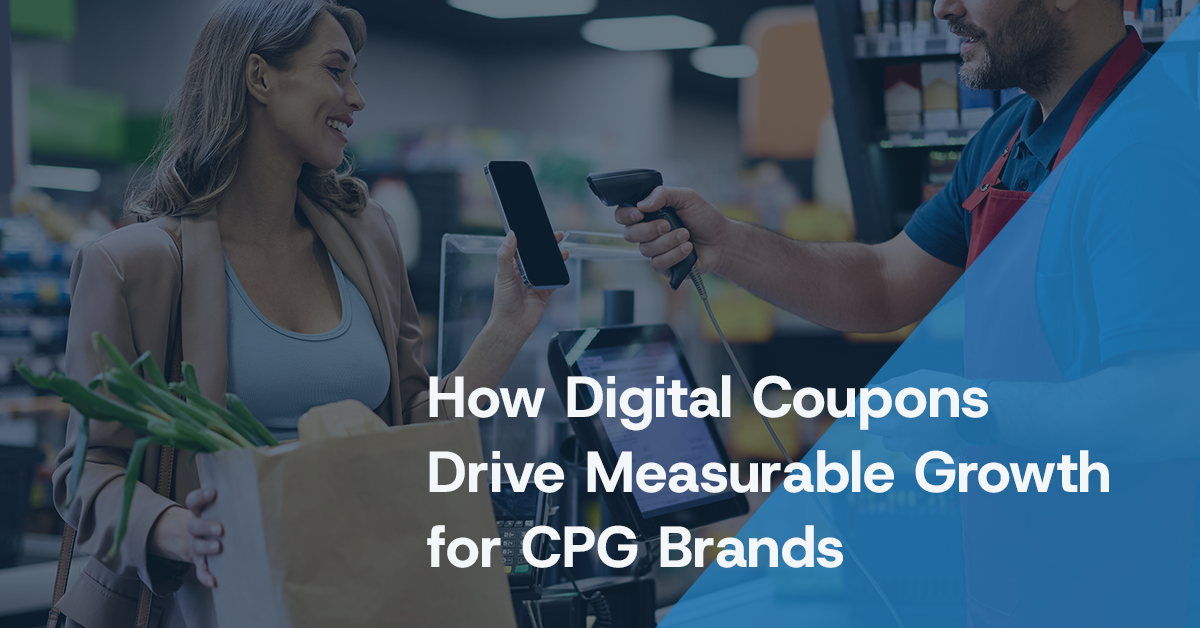
Digital coupons are no longer an emerging channel. Over three in five Americans actively search for promotions and coupon codes online, and digital coupons influence 69% of grocery sales. In 2025, digital load-to-card offers accounted for 53.9% of all coupon redemptions, while traditional FSIs represented just 2.3%, highlighting the rapid shift toward measurable, digitally validated promotions.
Key Takeaways
- Targeted digital coupons generate incremental sales — not just discounts. Digital coupons consistently outperform traditional paper coupons, with Inmar reporting substantially higher redemption and engagement rates than FSIs.
- SKU-level insight is the real competitive advantage. Unlike retailer clip-to-card programs, brand-owned digital coupon mechanics (barcode scan, receipt upload) return first-party purchase data directly to the brand — visibility traditional retail trade programs can't match.
- Pre- and post-purchase mechanics serve different strategic goals. Barcode-scan offers (pre-purchase) drive trial at shelf. Receipt-validated cashback (post-purchase) builds loyalty and deeper purchase-data capture. The best programs deploy both.
- Fraud prevention and targeting discipline protect ROI. Untargeted, unvalidated coupon campaigns lose 20–30% of discount budget to non-incremental sales. Purpose-built validation infrastructure closes that gap.
- Winning programs share a common architecture: clear objective, validated mechanics, real-time reporting, and structured optimization. This post walks through each layer.
- Retailer dependency: FSI and clip-to-card programs return aggregated data, often delayed, controlled by the retailer — not the brand.
- No SKU-level precision: Most trade spend produces category-level reporting at best. Brand marketers cannot identify which SKU, pack size, or retailer drove lift.
- No first-party profile: Promotions run through retailer ecosystems build retailer loyalty programs, not brand equity or brand-owned consumer data.
- Retailer where the purchase occurred
- Specific SKU and pack size redeemed
- Frequency and recency of the purchasing consumer
- Basket composition (via receipt) — including competitive products
- Time-to-redemption and geographic distribution
- Mid-campaign optimization: Identify underperforming SKUs, retailers, audiences, or regions and adjust targeting, media investment or incentive levels before budget is exhausted. Real-time visibility allows brands to improve performance while campaigns are still active rather than waiting for post-campaign reporting.
- Retailer negotiation leverage: First-party purchase data strengthens the brand's position in trade planning conversations.
- Media attribution: Match offer redemption events against media exposure data to calculate true channel ROI.
- Consumer segmentation: Build retargeting audiences based on actual purchase behavior — not modelled intent.
The ROI problem with most CPG promotions
In today's value-conscious environment, consumers expect personalized savings, digital convenience, and meaningful rewards. At the same time, CPG brands face increasing pressure to prove promotional effectiveness while protecting margins and maintaining pricing integrity.
Traditional couponing often struggles to meet these objectives. Brands invest heavily in trade promotions, FSIs, and retailer-led discount programs but frequently receive limited visibility into who purchased, what they purchased, and whether the promotion truly drove incremental sales.
Digital coupons change that equation. When built on validated mechanics such as barcode scans, receipt uploads, or purchase verification, digital coupon programs become more than discount vehicles. They become measurable growth engines that help brands drive trial, increase basket size, capture first-party data, and optimize future campaigns based on real consumer behavior.
For most CPG marketing leaders, the challenge isn't finding budget for promotions. It's proving which promotions actually work. This post explores how modern digital coupon programs solve that challenge and why leading brands are increasingly shifting toward retailer-agnostic, data-driven promotional strategies.
How Do Digital Coupons Drive Measurable Sales for CPG Brands?
The measurable difference comes down to validation. A coupon is not just a discount — it's a data-collection event. Whether a consumer scans a barcode before purchase or uploads a receipt after, each interaction generates structured purchase data the brand owns directly, without a retailer intermediary.
According to Inmar Intelligence, digital coupon redemption rates are consistently 3–5x higher than print FSIs, and validated digital offers reduce promotional waste by capturing confirmation of actual purchase rather than assumed redemption.
Why Traditional Trade Promotions Fall Short
- Retailer dependency: FSI and clip-to-card programs return aggregated data, often delayed, controlled by the retailer — not the brand.
- No SKU-level precision: Most trade spend produces category-level reporting at best. Brand marketers cannot identify which SKU, pack size, or retailer drove lift.
- No first-party profile: Promotions run through retailer ecosystems build retailer loyalty programs, not brand equity or brand-owned consumer data.
What Digital Validation Changes
When a CPG brand deploys a barcode-scan or receipt-upload mechanic, the data architecture inverts. The brand receives:
91% of consumers say they use digital coupons (Statista, 2024). More relevant to CPG brands: shoppers who redeem digital coupons spend on average 24% more per basket than non-coupon shoppers (Valassis/Vericast, 2023).
Why Consumers Respond to Digital Coupons
Digital coupons succeed because they create a clear value exchange between brands and consumers. Consumers receive immediate savings, cashback, rewards, or exclusive offers that help stretch their budgets. Brands gain measurable engagement, verified purchase activity, and insights into consumer behavior.
This alignment is particularly important as shoppers become increasingly selective about where and how they spend. Digital coupons provide a low-friction way to encourage trial, reduce purchase risk, and reward loyalty without requiring brands to permanently reduce shelf prices.
When consumers see relevant offers delivered through the channels they already use, participation increases and brands gain more opportunities to build long-term relationships rather than one-time transactions.
What Does a High-Performing CPG Coupon Program Look Like?
The most effective CPG digital coupon programs are structured around a clear strategic objective — trial, repeat purchase, basket expansion, or competitive switching — and they use mechanics aligned to that objective. There is no single template, but the architecture is consistent.
Pre-Purchase Programs: Driving Trial at Shelf
Barcode-scan offers activate consumers before they reach the checkout. A consumer scans a product barcode with their smartphone, confirms intent to purchase, and receives a digital reward or instant discount. The brand records the scan event in real time — retailer, location, SKU, device.
Snipp delivered a digital barcode-scan offer program for LEGO to drive product trial and shelf engagement. The program gave LEGO SKU-level scan data across multiple retail environments without requiring retailer POS integration, enabling the brand to track consumer engagement in real time and optimize offers mid-campaign.
Snipp ran a barcode-scan program for S.Pellegrino designed specifically to drive both sales volume and basket size. By targeting specific SKUs and pack sizes, the program provided granular insight into which products drove the strongest incremental purchase behavior — data the brand could take directly into trade planning.
Post-Purchase Programs: Validating Purchase and Building Loyalty
Receipt-upload cashback mechanics validate that a purchase actually occurred before any incentive is paid. This is the strongest fraud-prevention layer available to CPG brands, and it produces the richest first-party data set: full basket contents, retailer identity, purchase frequency, and price paid.
Snipp delivered a digital cashback offer for Starbucks chilled coffee beverages to drive trial of a premium price-tier product. The receipt-validated mechanic confirmed real purchase events while capturing basket data that demonstrated the product's performance alongside complementary categories — insight that influenced both media targeting and retail ranging decisions.
Beyond Trial: Turning Coupon Users into Loyal Customers
The most successful digital coupon programs don't end with a single purchase. Brands increasingly use promotions to encourage repeat buying behavior through tiered rewards, multi-purchase incentives, portfolio-wide offers, and personalized follow-up campaigns. Rather than simply rewarding one transaction, these programs create a progression that keeps consumers engaged over time.
Examples include:
-
Increasing reward values after a second or third purchase
-
Cross-brand portfolio offers that encourage consumers to explore additional products
-
Seasonal promotions tied to key consumption occasions
-
Personalized offers based on previous purchase behavior
When combined with validated purchase data, these strategies help brands transform promotional activity into a long-term loyalty and retention engine.
CPG Coupon mechanics compared: Which is right for your program?
Not all digital coupon mechanics are equivalent. The right choice depends on your objective, your retailer relationships, and how much first-party data you need to capture. The table below maps the key trade-offs.
|
Mechanic |
Data Quality |
Fraud Risk |
Retailer Dependency |
Measurement Precision |
|
Barcode Scan (Pre-Purchase) |
High — SKU-level, retailer-agnostic |
Low — no receipt needed |
None — consumer scans barcode directly |
Very High — real-time scan tracking, geo data |
|
Receipt Upload (Post-Purchase) |
Very High — basket-level purchase data |
Low — receipt validates actual purchase |
None — works at any retailer |
High — confirms sell-through with retailer ID |
|
Promo / Unique Code |
Medium — tied to user account or channel |
Medium-High — generic codes shareable/leakable |
High — often requires retailer checkout integration |
Medium — channel attribution only, no SKU detail |
|
Clip-to-Card / Retailer Digital |
Low — depends on retailer data-sharing agreement |
Low — retailer manages redemption |
Very High — brand locked into retailer ecosystem |
Low — aggregated data, delayed, no 1P ownership |
Table: CPG digital coupon mechanics compared across data quality, fraud risk, retailer dependency, and measurement precision.
For most mid-to-large CPG brands, a barcode-scan or receipt-upload mechanic delivers significantly stronger measurement and brand data ownership than retailer-dependent alternatives. Snipp's Coupon Management System is designed specifically for this architecture — enabling brands to run retailer-agnostic promotions with full SKU-level reporting.
What Are the Common Pitfalls of Digital Coupon Campaigns?
Most underperforming CPG coupon campaigns fail for one of four reasons. Each is avoidable with the right program design.
1. Targeting the Already-Converted
Distributing offers broadly to your existing loyal buyers does not generate incremental revenue — it simply discounts purchases that would have occurred anyway. High-performing programs use purchase history to identify lapsed buyers, competitive switchers, and category-adjacent consumers. Targeting precision is where ROI is won or lost.
2. No Fraud Prevention Infrastructure
Coupon fraud and misuse remain a significant industry challenge, making receipt validation, OCR, and duplicate-submission detection important safeguards for promotional budgets. Receipt-OCR technology, device fingerprinting, and duplicate-submission detection are table stakes for any campaign above $50K in promotion value. Without them, brands are effectively subsidizing non-incremental purchases.
3. Over-Discounting Premium SKUs
Deep discounts on premium products train consumers to wait for the offer rather than purchase at full price. A cashback structure (where consumers pay full price first and receive a rebate after validation) preserves the perceived price point while still delivering value — a critical distinction for premium-tier CPG products.
4. No Measurement Framework Before Launch
Too many campaigns are designed without defining what "success" means in advance. Without a pre-agreed measurement framework — incremental sales lift, trial rate, repeat purchase within 90 days — post-campaign reporting becomes difficult to act on. Define the KPIs before the creative is built.
How Do CPG Brands Build Retailer-Independent Measurement?
This is the core challenge for brand marketers: spend runs through agencies and retailers, but the data that comes back is filtered, aggregated, and delayed. Digital coupon programs built on brand-owned validation infrastructure break that dependency.
The key principle is that measurement comes from the validation event — not from the retailer's POS. When a consumer scans a barcode or uploads a receipt directly to a brand-hosted offer page, the purchase confirmation is brand-owned. The retailer remains the fulfillment channel, but the data belongs to the brand.
What Real-Time Reporting Enables
- Mid-campaign optimization: Identify underperforming SKUs, retailers, audiences, or regions and adjust targeting, media investment or incentive levels before budget is exhausted. Real-time visibility allows brands to improve performance while campaigns are still active rather than waiting for post-campaign reporting.
- Retailer negotiation leverage: First-party purchase data strengthens the brand's position in trade planning conversations.
- Media attribution: Match offer redemption events against media exposure data to calculate true channel ROI.
- Consumer segmentation: Build retargeting audiences based on actual purchase behavior — not modelled intent.
|
For CMOs and CCOs In crowded, low-growth CPG categories, incremental gains come from smarter activation — not bigger budgets. Brands that own their promotion data consistently outperform those running trade through retailer-controlled programs, because they can iterate faster and target more precisely. |
How Snipp Approaches CPG Coupon Programs
Snipp's Digital coupon solution is built specifically for CPG brands that need retailer-agnostic coupon offer promotion infrastructure with first-party data capture. The platform supports barcode-scan and receipt-upload mechanics with integrated fraud prevention, real-time reporting dashboards, and campaign optimization built in.
Programs are configurable by SKU, region, retailer, consumer segment, and reward structure. Brands retain full ownership of all consumer and purchase data generated. There are no retailer data-sharing agreements to negotiate and no POS integration requirements.
Explore the full case study library for Digital Coupon programs on snipp.com to see how CPG brands across beverages, food, and household categories have used this infrastructure.
While this article focuses on digital coupons, brands can move toward unified promotional ecosystems that combine coupons, cashback offers, rebates, loyalty programs, sweepstakes, and purchase-based rewards. By managing these initiatives through a single platform, brands can create more connected consumer experiences while maintaining a consistent view of performance, audience behavior, and ROI.
Frequently Asked Questions
Are digital coupons effective for CPG brands?
Yes — with important caveats. Digital coupons consistently outperform print FSIs on redemption rates (3–5x higher per Inmar Intelligence). The effectiveness depends on targeting precision, validation mechanics, and whether the program is designed to drive incremental purchases versus rewarding existing buyers. Brands with structured programs report 25–40% incremental sales lift on targeted SKUs.
How do CPG brands prevent coupon fraud?
Receipt validation is the primary layer — it confirms that a purchase occurred at a specific retailer before any reward is issued. Additional fraud prevention includes receipt OCR with AI-powered line-item verification, device fingerprinting to prevent duplicate submissions, purchase-velocity limits per consumer, and blacklisting of known fraudulent account patterns. Snipp's platform includes all of these layers as standard infrastructure.
What is the ROI of digital coupons for CPG brands?
ROI varies significantly by category, mechanic, and targeting approach. The most relevant benchmark is incremental sales lift per dollar of promotion spend — the most rigorous programs calculate this by comparing redemption groups against matched control groups. Brands should measure success using incremental sales lift, redemption rate, basket growth, repeat purchase behavior, and retailer-level performance rather than relying on redemption volume alone.
Conclusion
Digital coupons are not simply a budget line for discounting. They are an investment in measurable growth, first-party data, and customer intelligence. The brands generating consistent incremental growth are not necessarily running larger promotions. They are running smarter ones, using validated mechanics, real-time reporting, fraud prevention, and retailer-independent measurement to understand exactly what drives performance.
As retailers continue to control more shopper data, the future belongs to brands that build direct visibility into consumer purchasing behavior. Digital coupon programs provide a practical and scalable path to achieving that goal.
What's Next
If this post describes the measurement gap you're currently experiencing or a program you're planning to build, here are the logical next steps:
- Audit your current promotion stack. Map which mechanics return first-party SKU-level data and which depend on retailer data sharing. Identify the gaps.
- Define your objective and the right mechanic. Trial and shelf engagement point toward barcode-scan. Loyalty and repeat purchase point toward receipt validation. Most mature programs run both.
- Review the case library. Explore Snipp's Digital Coupon case studies to see how CPG brands across categories have structured their program.
- Speak to a specialist. Snipp works with mid-to-large CPG brands to design, build, and measure digital coupon promotion programs. Bring a campaign brief and we will walk you through what a validated digital coupon program would look like for your category.
Ready to Build a Coupon Program That Proves Its Own ROI?
Snipp works with CPG brands to design, execute, and measure digital coupon programs built on validated mechanics and first-party data. No retailer dependency. Full SKU-level reporting.
Learn more at https://www.snipp.com/digital-coupon-management-software or if you are ready to put digital coupons to work as part of a smarter promotional marketing strategy, contact us here.
Subscribe for updates straight to your inbox